

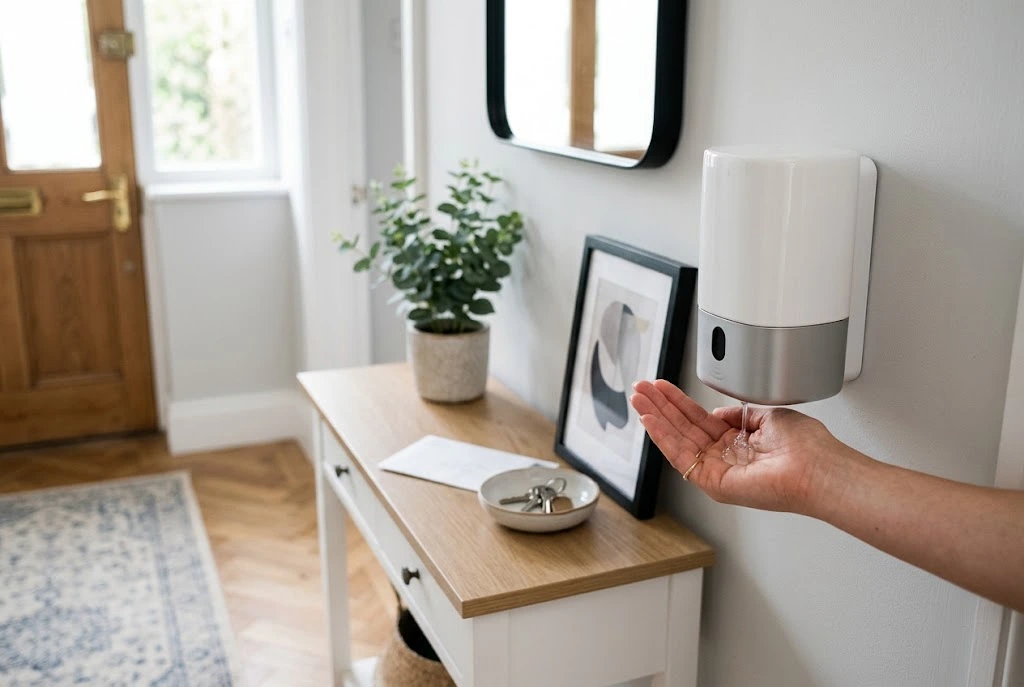
Touchless hand sanitizer dispensers can make everyday hand hygiene more convenient at home. Instead of pressing a pump with your hand, an automatic dispenser uses a sensor to detect your hand and release a measured amount of sanitizer.
For households, the appeal is simple: less contact with the dispenser, more consistent dispensing and easier access to hand sanitiser in busy areas such as entrances, kitchens and home offices.
However, not every automatic dispenser is equally suitable for residential use. Sensor reliability, refill compatibility, capacity, power source and resistance to moisture can make a significant difference to the experience.
What Is a Touchless Hand Sanitizer Dispenser?
A touchless hand sanitizer dispenser is an automatic device that releases hand sanitiser when its sensor detects a hand underneath or in front of the dispensing nozzle.
Most models use an infrared or similar proximity sensor connected to a small pump mechanism. When a hand enters the detection area, the sensor triggers the pump and delivers a predetermined amount of liquid or gel.
The user does not need to press a button or touch the dispenser itself.
Why Use a Touchless Dispenser at Home?
A conventional pump bottle requires the user to touch the pump before applying sanitiser. A touchless model removes that particular contact point.
This can be especially convenient when several people use the same dispenser throughout the day. It can also be useful when someone’s hands are visibly dirty, wet or occupied.
Automatic dispensing can also help control the amount released during each use. Instead of manually pressing the pump repeatedly, the dispenser determines the dose according to its settings.
Current automatic-dispenser comparisons commonly focus on sensor responsiveness, dispensing consistency, durability, battery life and ease of cleaning because these factors have a direct effect on everyday usability.
Where Should You Put a Touchless Sanitizer Dispenser?
Location matters almost as much as the dispenser itself. The most useful position is usually somewhere people naturally pass through or where hand hygiene is particularly convenient.
Near the Front Door
An entrance is one of the most practical locations. Household members and visitors can sanitise their hands when entering or leaving without needing to search for the bottle.
A countertop dispenser can work on an entry table, while a wall-mounted model can save space in a narrow hallway.
In the Kitchen
A kitchen dispenser can be useful when you want quick access to sanitiser without repeatedly touching a shared pump.
Keep it away from direct food-preparation surfaces and avoid positioning electronic equipment where it can be regularly exposed to water or heavy splashing.
In a Home Office
A small automatic dispenser can also be useful in a home office, particularly when several people share the workspace.
A compact model is usually preferable here because a large commercial dispenser can take up unnecessary desk or shelf space.
In a Utility or Family Area
Homes with children may benefit from having a dispenser in an area where people regularly come and go. A touchless design also means children do not need to operate a stiff mechanical pump.
What Should You Look for in a Touchless Hand Sanitizer Dispenser?
The cheapest automatic dispenser is not necessarily the best option. A few specifications are particularly important when choosing one for residential use.
1. Sensor Reliability
The sensor is arguably the most important component. If it fails to detect your hand consistently, the main advantage of going touchless disappears.
Look for a dispenser with a responsive detection system and a sensible activation range. The hand should be detected without requiring repeated waving or precise positioning.
Recent dispenser testing guides also place sensor responsiveness high on the list of factors to evaluate.
2. Dispensing Amount
Different dispensers release different amounts of product per activation. Some models provide adjustable volume settings, while others use a fixed dose.
An adjustable dispenser can be useful because households have different preferences. A smaller dose may be suitable for everyday use, while some users may prefer a larger amount.
Avoid assuming that the largest dose is automatically better. Excess product can create unnecessary waste and leave more residue on the hands.
3. Capacity
Capacity determines how frequently you will need to refill the dispenser.
A compact dispenser may be perfectly adequate for a guest bathroom or low-traffic area. A larger reservoir makes more sense for a busy entrance or household with several users.
Current home-dispenser comparisons include capacities ranging from small countertop reservoirs to units exceeding one litre, demonstrating how widely products differ in intended use.
4. Battery or Rechargeable Power
Automatic dispensers need a power source. Battery-operated models are convenient because they can be installed almost anywhere, while rechargeable units eliminate the need to keep replacement batteries available.
Before buying, check how the device is powered and whether it can operate while charging if the battery becomes empty.
If you choose a battery-powered model, consider how frequently the dispenser will be used. High-traffic locations can consume batteries more quickly.
5. Refill Compatibility
Do not assume that every automatic dispenser accepts every type of hand sanitiser.
Some units are designed for particular liquid consistencies, while others may be intended for specific refill cartridges. A dispenser designed for a particular formulation may not perform properly with a thicker or thinner product.
Always check the manufacturer’s compatibility instructions before filling the reservoir.
6. Moisture Resistance
Bathrooms and kitchens can expose electronic dispensers to water, steam and splashes. If the device will be used in one of these environments, check its stated resistance to moisture.
A dispenser designed primarily for dry indoor areas may not be the best choice for a location next to a frequently used sink.
7. Easy Refilling and Cleaning
A good dispenser should be straightforward to refill and wipe clean. Narrow openings can make refilling messy, while complicated removable reservoirs can make routine maintenance frustrating.
Also inspect the dispensing nozzle regularly. Sanitiser residue can build up around the outlet over time, particularly if the product dries around the opening.
Automatic vs Manual Sanitizer Dispensers
Touchless dispensers are not automatically better for every household. Manual dispensers have several advantages, including simplicity, lower purchase cost and no need for batteries or charging.
| Feature | Touchless Dispenser | Manual Dispenser |
|---|---|---|
| Operation | Sensor activated | Hand operated |
| Physical contact | No dispenser contact required | User presses the pump |
| Power | Usually batteries or rechargeable | No power required |
| Dosing | Usually controlled automatically | Depends on how the pump is pressed |
| Maintenance | Batteries/charging plus cleaning | Primarily cleaning and refilling |
| Typical cost | Higher | Lower |
If convenience and reduced contact are the priorities, touchless is attractive. If simplicity and low cost matter more, a traditional pump can still be perfectly practical.
Wall-Mounted or Countertop?
The right mounting style depends on the space available.
Wall-mounted dispensers are useful in narrow hallways, shared bathrooms and busy areas where keeping the counter clear is important. They can also provide a consistent location that everyone in the household knows.
Countertop dispensers are easier to move and usually require less installation. They can be placed on an entrance table, bathroom counter or other suitable surface.
For renters or people who frequently change the layout of their home, countertop models may be the more convenient choice.
Liquid or Gel Sanitizer?
Sanitiser formulations vary in thickness, and that can affect how an automatic dispenser performs.
Before buying a device, check whether the manufacturer specifies a particular type or viscosity. A pump designed for a relatively thin formulation may struggle with a thicker gel.
Do not dilute hand sanitiser simply to make it work in a dispenser unless the product manufacturer specifically instructs you to do so. Altering the formulation can change its properties.
Are Touchless Dispensers More Hygienic?
A touchless dispenser eliminates the need to physically press the dispenser, which can reduce contact with the dispenser surface itself.
However, the dispenser is only one part of hand hygiene. A sensor-operated pump does not replace proper handwashing when washing with soap and water is appropriate.
It is also important to keep the dispenser clean. The nozzle, housing and surrounding surface can still accumulate residue and dirt even when users never touch the pump.
How to Keep an Automatic Sanitizer Dispenser Working Properly
Regular maintenance can help prevent many common problems.
- Clean the exterior regularly: Wipe the housing according to the manufacturer’s instructions.
- Keep the sensor clear: Dirt or residue can interfere with detection.
- Inspect the nozzle: Remove dried product around the dispensing outlet.
- Do not overfill: Leave enough space if the manufacturer recommends it.
- Use compatible sanitiser: Follow the dispenser’s product requirements.
- Replace batteries when necessary: Weak batteries can cause inconsistent dispensing.
- Keep water away from electronic components: Especially important around sinks and wet areas.
Common Problems With Touchless Dispensers
The Sensor Does Not Detect Your Hand
First check the batteries or charge level. Then clean the sensor area and make sure the hand is positioned within the recommended detection range.
The Dispenser Releases Too Much Sanitiser
If the model has adjustable settings, reduce the dispensing volume. If it does not, check whether the product is operating according to its specifications.
The Pump Stops Working
A low battery, blocked nozzle or incompatible sanitiser can all cause dispensing problems. Check the reservoir and nozzle before assuming that the motor has failed.
The Dispenser Leaks
Check the reservoir, cap and nozzle connections. A damaged seal or unsuitable refill can cause leakage. Do not continue using an electronic dispenser if liquid is entering areas that the manufacturer says should remain dry.
How Much Should You Spend?
There is no need to buy the most expensive dispenser for a normal household.
Budget models can provide basic automatic dispensing, while mid-range products may offer better construction, adjustable dosing, rechargeable batteries or larger reservoirs.
Premium models can make sense when appearance, durability, reliability or frequent use justify the additional cost.
Rather than choosing purely by price, compare the features you will actually use. A £20 dispenser with a suitable sensor and refill system may be more useful than a £70 model whose additional features provide little benefit to your household.
Are Touchless Sanitizer Dispensers Worth It for Homes?
For many households, the answer is yes if convenience and reduced contact are priorities.
The biggest benefit is not that the dispenser somehow replaces good hygiene practices. It is that it makes sanitiser easier to use without touching a shared pump.
The technology is also relatively simple. A reliable sensor, consistent pump and suitable reservoir are generally more important than unnecessary smart features.
Frequently Asked Questions
What is the best touchless hand sanitizer dispenser for a home?
The best model depends on your space, budget, sanitiser type and preferred power source. Prioritise sensor reliability, compatible refills, suitable capacity and easy maintenance rather than choosing purely by brand or price.
Do touchless sanitizer dispensers need batteries?
Most automatic models need either disposable batteries, a rechargeable battery or a mains power connection. Check the specific model before buying.
Can I use any hand sanitizer in an automatic dispenser?
Not necessarily. Check the manufacturer’s compatibility requirements. Different dispensers can be designed for different liquid consistencies or refill systems.
Are wall-mounted dispensers better?
Wall-mounted models are useful when counter space is limited or you want a fixed location. Countertop models are easier to move and generally simpler to install.
Can touchless dispensers be used in bathrooms?
Yes, but choose a model appropriate for the environment and follow its moisture-resistance instructions. Electronic dispensers should not be exposed to unnecessary water or splashing.
How often should an automatic sanitizer dispenser be cleaned?
Clean it regularly according to the manufacturer’s instructions, paying particular attention to the sensor, nozzle and areas where sanitiser residue accumulates.
Final Thoughts
Touchless hand sanitizer dispensers can be a convenient addition to a modern home, particularly in entrances, kitchens, bathrooms and shared workspaces.
The best choice is not necessarily the most expensive or the one with the fastest advertised sensor. Look for a reliable detection system, appropriate capacity, compatible sanitiser, sensible dosing, convenient power and construction suitable for the location where you plan to use it.
Most importantly, treat an automatic dispenser as a convenience tool rather than a replacement for proper handwashing. With the right model and regular maintenance, however, it can make everyday hand hygiene simpler and easier for the whole household.
