

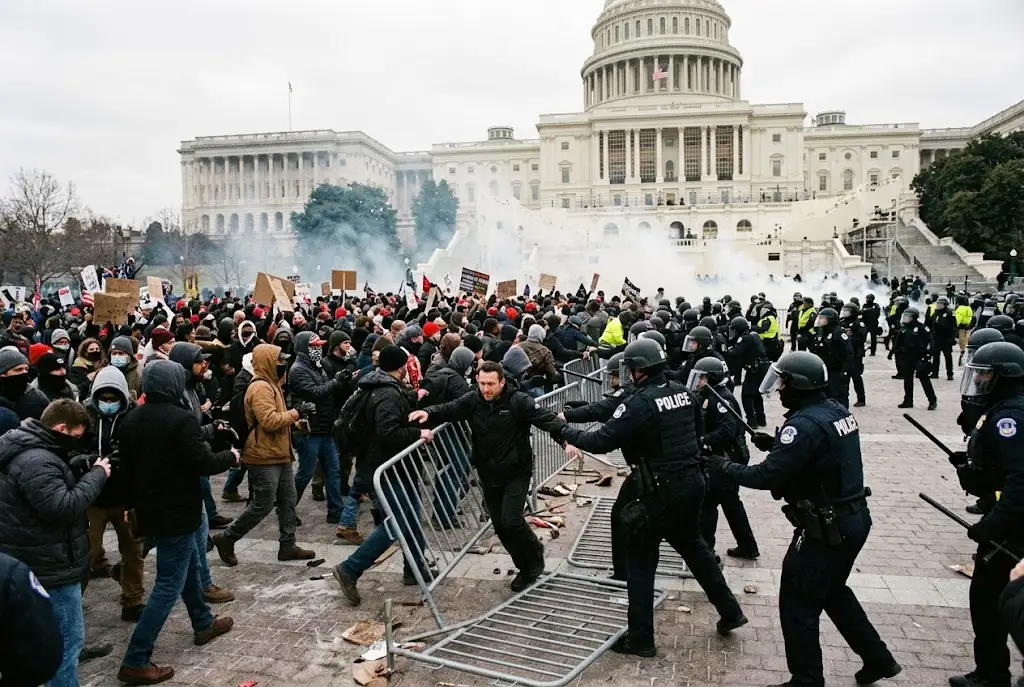
The 6 January 2021 attack on the US Capitol brought together a wide range of people with different political beliefs and motivations. In the days and weeks after the violence, researchers began identifying members and supporters of multiple extremist movements among those who travelled to Washington, DC and participated in the riot.
A January 2021 investigation by Voice of America reported that researchers had identified members of more than a dozen extremist groups or movements among those involved. The groups and individuals varied considerably, and not everyone present at the Capitol belonged to an organised extremist organisation.
Later investigations and federal criminal cases provided additional evidence of the involvement of organisations including the Proud Boys, Oath Keepers and people affiliated with Three Percenter militia movements.
What Happened on January 6, 2021?
On 6 January 2021, a large crowd gathered in Washington, DC, as Congress met to certify the electoral votes from the 2020 US presidential election.
The event developed into a violent breach of the US Capitol. Rioters broke through police lines and barricades, entered restricted areas and forced their way into parts of the Capitol building. Members of Congress and staff were evacuated or sheltered while law enforcement officers attempted to regain control of the building.
The attack disrupted the congressional proceedings for several hours before lawmakers eventually returned to complete the certification process.
More Than a Dozen Groups Were Identified
In the immediate aftermath, researchers examined photographs, videos, social media posts, clothing, flags, insignia and other evidence to identify participants connected to extremist movements.
A January 16, 2021 report by Voice of America said researchers had identified members of more than a dozen extremist groups that took part in the riot. The analysis included established organisations, smaller regional groups and broader movements that did not operate as conventional membership organisations.
Researchers also stressed that the exact number of extremist-group members who participated could not be determined with certainty. Many people at the Capitol had no identifiable organisational affiliation.
The Proud Boys
The Proud Boys were among the groups that received significant attention following the attack.
The organisation had been active at political demonstrations in the United States before January 2021. Members travelled to Washington for events surrounding the certification of the 2020 election, and investigators later established that senior Proud Boys figures and members played significant roles in the events leading up to and during the Capitol attack.
Federal prosecutors subsequently brought major criminal cases against Proud Boys leaders. In 2023, a federal jury convicted several senior members of seditious conspiracy and related offences arising from their conduct surrounding January 6.
Those cases provided substantially more evidence about the organisation’s planning and role than was available immediately after the riot.
The Oath Keepers
The Oath Keepers, another anti-government extremist organisation, were also prominent in investigations into January 6.
Federal prosecutors established that members and leaders of the organisation travelled to the Washington area and coordinated before and during the attack.
In January 2023, a federal jury found Oath Keepers leaders guilty of seditious conspiracy in connection with their actions surrounding the Capitol breach. The evidence presented at trial described preparations, encrypted communications and coordinated movements by members and affiliates.
Additional Oath Keepers members and affiliates were later convicted of conspiracy and other offences connected to the attack.
Three Percenter Militias
Three Percenter ideology was another recurring feature in investigations into January 6.
The Three Percenters are associated with an anti-government militia movement whose adherents claim ideological links to a disputed interpretation of the American Revolutionary War.
Federal cases later established that people associated with Three Percenter groups travelled to Washington and participated in activities surrounding the Capitol breach.
In one case, prosecutors described members of a Florida-based militia-style organisation that adhered to Three Percenter ideology travelling to Washington together before the attack. Other federal prosecutions involved Three Percenter militia members who coordinated travel and discussed plans for January 6.
QAnon and Other Conspiracy Movements
QAnon was also visible among people who gathered in Washington on January 6.
Unlike organisations such as the Proud Boys or Oath Keepers, QAnon is better understood as a conspiracy-theory movement rather than a conventional organisation with a formal membership structure.
Researchers identified QAnon supporters among people present at the Capitol, including individuals displaying symbols and references associated with the movement.
This distinction is important because the wider January 6 crowd included people influenced by online conspiracy narratives without necessarily belonging to an organised extremist group.
White Supremacist and Groyper Networks
Researchers also identified individuals connected to white supremacist and Groyper networks among the participants.
Some of these individuals had previously attended far-right demonstrations or other political events. Their presence demonstrated that the January 6 crowd included people from several overlapping extremist subcultures rather than one unified organisation.
The Anti-Defamation League later conducted its own analysis of people identified as having breached the Capitol. Its research found direct ties to several extremist organisations and movements, including the Proud Boys, Oath Keepers, Groypers, white supremacists and QAnon.
Not Everyone Was Part of an Extremist Group
One of the most important qualifications in the research is that the January 6 crowd cannot accurately be described as a gathering made up entirely of members of extremist organisations.
Researchers identified many people who had no known organisational affiliation. Some were part of a decentralised pro-Trump movement, while others appeared to have been motivated by election-related conspiracy theories or political grievances.
The Anti-Defamation League’s February 2021 analysis illustrates this distinction. Among 212 people it had positively identified at that stage, 52 had direct ties to known right-wing extremist groups. The remainder included people classified as part of a broader decentralised pro-Trump extremist movement or people without the same organisational connections.
This evidence shows why it is more accurate to say extremist groups and movements were represented among the rioters rather than claiming that every participant belonged to one.
How Researchers Identified Group Affiliations
Much of the early research relied on publicly available evidence.
Photographs and videos showed distinctive clothing, patches, flags and other symbols. Researchers also examined social media accounts, previous public appearances and statements made by participants.
In some cases, the evidence was later supplemented by federal investigations, court documents and testimony presented at criminal trials.
This process meant that the understanding of January 6 changed over time. Initial reporting identified possible affiliations, while subsequent prosecutions provided more detailed evidence about the activities of particular individuals and organisations.
What Later Federal Cases Established
The years following January 6 produced a substantial federal criminal investigation.
Cases involving Oath Keepers and Proud Boys leaders established that some senior members had coordinated before the attack and were convicted of serious federal offences.
Federal prosecutors also brought cases against people associated with Three Percenter organisations and other militia-style groups. These cases documented coordinated travel, communications and participation in the events around the Capitol.
That later evidence is important when looking back at the original January 2021 reporting because researchers at the time were working with incomplete information.
Was January 6 a Coordinated Attack by Every Group?
No. The presence of multiple extremist groups did not mean that every participant operated under a single unified command structure.
The January 6 crowd contained people with different backgrounds, organisations and motivations. Some groups had their own planning and leadership structures, while many other participants appear to have acted independently.
Federal prosecutions have nevertheless demonstrated that certain organisations, particularly the Oath Keepers and senior Proud Boys members, engaged in specific forms of planning and coordination surrounding the attack.
The distinction between individual participation, group affiliation and coordinated criminal conduct is therefore important when describing what happened.
Why the Research Matters
Identifying the different groups represented on January 6 helped researchers understand the broader extremist landscape surrounding the attack.
The evidence showed that established extremist organisations, conspiracy movements and unaffiliated political activists could overlap in the same physical event even when their organisational structures and ideologies differed.
It also demonstrated the importance of examining online activity alongside events on the ground. Researchers were able to trace some affiliations through social media posts, public statements and digital communities.
The January 6 Investigation Continued for Years
The initial reports published in January 2021 represented only an early snapshot of the investigation.
Federal authorities continued identifying suspects, collecting evidence and prosecuting participants for years after the Capitol breach. Court proceedings involving members and leaders of extremist organisations added further information about planning and participation.
As a result, some claims made immediately after January 6 were later supported, refined or given greater context by evidence presented in court.
Frequently Asked Questions
How many extremist groups were identified among January 6 participants?
Contemporary researchers interviewed by Voice of America identified members of more than a dozen extremist groups or movements among those involved. The precise number of organisations represented remains difficult to establish because many participants had no formal group affiliation.
Which major extremist groups were involved?
Investigations identified members and affiliates associated with groups and movements including the Proud Boys, Oath Keepers, Three Percenter militias, QAnon, Groypers and other white supremacist networks.
Were all January 6 rioters members of extremist groups?
No. A substantial number of participants did not have known membership in an extremist organisation. Researchers identified a mixture of organised extremists, conspiracy-theory adherents, political activists and unaffiliated individuals.
Were Proud Boys leaders convicted?
Yes. Several senior Proud Boys figures were convicted of seditious conspiracy and related federal offences arising from their conduct surrounding January 6.
Were Oath Keepers leaders convicted?
Yes. Oath Keepers leaders were convicted of seditious conspiracy and other offences connected with the Capitol breach.
January 6 in Historical Perspective
The January 6 Capitol riot remains one of the most extensively investigated episodes of political violence in recent US history.
Early research quickly established that people associated with multiple extremist movements were present. Subsequent investigations and federal trials provided a much clearer picture of the roles played by particular organisations and individuals.
The evidence also demonstrates why the event should not be reduced to a single group or ideology. The crowd included organised extremist groups, conspiracy movements and people with no formal organisational affiliation.
For historical reporting, the most accurate conclusion is that multiple extremist organisations and movements were represented among the people who participated in the January 6 Capitol attack, while the wider crowd was considerably more diverse in its affiliations and motivations.
For more historical and political coverage from WebVibe, readers can explore the site’s Latest section.
Sources
The article draws on contemporary research and subsequent federal court records concerning the January 6 Capitol breach.
Voice of America: Researchers identify more than a dozen extremist groups
Anti-Defamation League: Analysis of domestic extremists involved in January 6
US Department of Justice: Oath Keepers seditious conspiracy convictions
US Department of Justice: Proud Boys leaders sentenced for January 6 offences
US Department of Justice: Three Percenter convictions related to January 6
