

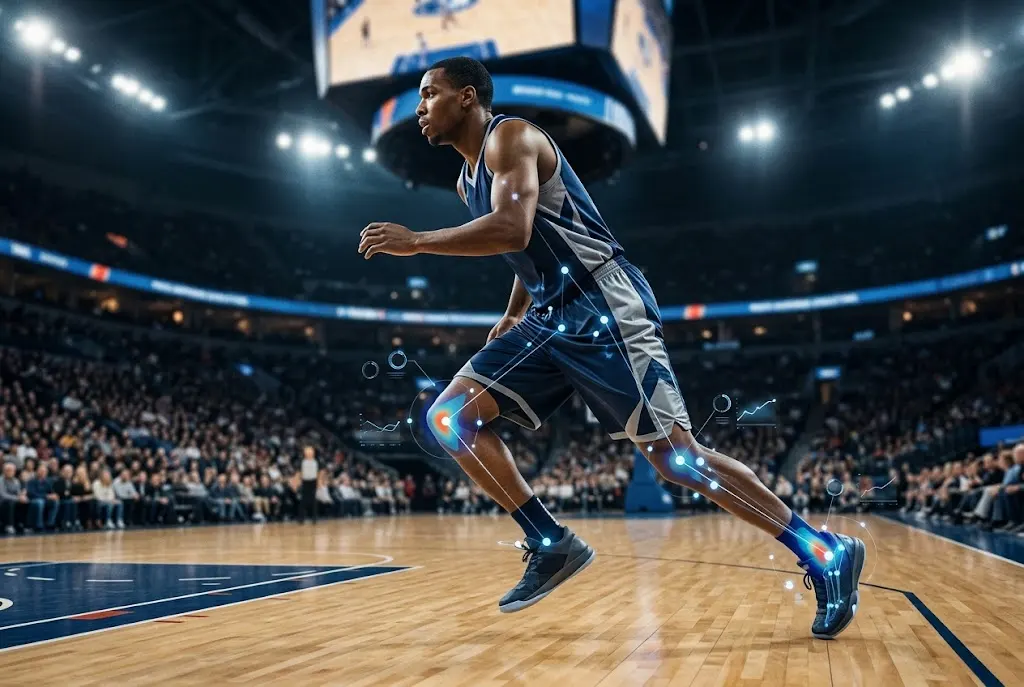
Basketball is a fast, physically demanding sport in which players repeatedly accelerate, stop, jump, land and change direction. Those movements create considerable physical demands, particularly on the knees, ankles, muscles and other parts of the lower body.
That has made injury prevention an increasingly interesting application for artificial intelligence. Researchers are now using machine learning models to analyse training loads, previous injuries, movement patterns, physical characteristics and other forms of athlete data in an attempt to identify players who may face an elevated injury risk.
But there is an important distinction between identifying risk and predicting an injury with certainty. Current research suggests AI can identify useful patterns, but it is not a crystal ball that can reliably tell coaches exactly when a player will get injured.
Why Is AI Being Used to Predict Basketball Injuries?
Traditional injury assessment relies heavily on medical examinations, player history, physical testing, coaching observations and sports-science data.
These methods remain important, but modern athletes generate enormous amounts of additional information. Training sessions can produce data about workload and intensity, while wearable technologies can provide information about movement and physiological responses.
AI and machine learning can analyse relationships across large datasets that would be difficult to evaluate manually.
Instead of asking whether one individual factor causes an injury, an algorithm can examine combinations of variables and look for patterns associated with previous injuries.
That makes AI potentially useful as a decision-support tool for sports scientists, medical teams and coaches.
What Data Can an Injury-Prediction Model Analyse?
The quality of an AI prediction depends heavily on the quality of the information provided to the model.
Depending on the research project, injury-risk models may use several categories of data.
- Previous injuries: A player’s injury history can provide important context for assessing future risk.
- Training load: Workload, intensity and changes in training volume can be monitored over time.
- Movement data: Biomechanical measurements can reveal information about how an athlete runs, jumps, lands or changes direction.
- Physical characteristics: Strength, flexibility, body measurements and other physical variables may be incorporated.
- Performance data: Changes in athletic performance can provide additional information about fatigue or physical condition.
- Physiological information: Depending on the system, heart rate and other measurable physiological variables may contribute to the dataset.
The more comprehensive the dataset, the more opportunities an algorithm has to identify relationships. However, more data does not automatically mean better predictions. Poor-quality or inconsistent data can produce misleading results.
How Does Machine Learning Actually Predict Injury Risk?
Machine learning systems learn from existing data rather than relying exclusively on manually programmed rules.
Researchers can provide an algorithm with historical information from athletes and identify which players experienced particular injuries. The model then searches for patterns that distinguish higher-risk and lower-risk cases.
Once trained, the model can be tested on data it has not previously seen.
A simplified example might look like this:
- Collect historical athlete data.
- Record relevant injury outcomes.
- Prepare and clean the dataset.
- Train a machine learning model.
- Test the model against separate data.
- Measure how accurately it identifies elevated injury risk.
This process sounds straightforward, but the quality of the result depends on how the research is designed. Small datasets, inconsistent injury definitions and insufficient external validation can all make an impressive-looking model less useful in real-world settings.
Can AI Really Predict When a Basketball Player Will Get Injured?
Not with certainty.
This is probably the most important point when discussing AI-based injury prediction.
An algorithm can identify patterns associated with increased risk, but an elevated-risk prediction does not mean an injury is guaranteed to happen.
Likewise, a low-risk prediction does not mean an athlete cannot become injured.
Sports injuries are influenced by many interacting factors, including movement, fatigue, previous injuries, training load, contact with other players and circumstances that may be difficult to capture in a dataset.
A player can also suffer an unexpected injury because of a collision or awkward landing that an algorithm could not reasonably anticipate.
What Does the Research Say?
The evidence is promising but far from conclusive.
A 2026 systematic review and meta-analysis of machine-learning sports-injury prediction models found considerable predictive potential across the studies examined. However, the researchers also highlighted methodological differences between models and recommended improvements such as better handling of imbalanced datasets, stronger validation methods and the use of time-series information.
Another 2026 systematic review of AI applications in sports injury prediction found that the technology can process training-load, physiological, biomechanical and psychological information, but most existing models still rely heavily on internal validation. That limits confidence in how well they will perform with new athletes and different sporting environments.
This is a recurring theme in AI research: a model can perform well in the dataset on which it was developed without necessarily performing equally well when introduced to a completely different group of athletes.
What About Basketball-Specific Research?
Basketball provides a particularly interesting environment for injury prediction because athletes perform repeated cutting, jumping and landing movements.
One 2025 study examined machine-learning approaches for predicting ACL injury incidence in male basketball players. The researchers analysed physical, basketball-specific, biomechanical and electromyographic variables from collegiate players.
The study found that machine-learning models could identify factors associated with ACL injury risk. The random forest model produced the strongest reported performance, with an area under the receiver operating characteristic curve of 0.80.
That is encouraging, but it is also important to interpret the result correctly. An AUC of 0.80 indicates useful discrimination between higher- and lower-risk cases in that study. It does not mean the algorithm can predict exactly which individual player will suffer an ACL injury.
Why ACL Injuries Are an Important Test Case
Anterior cruciate ligament injuries are particularly significant in basketball because the sport involves frequent jumping, rapid deceleration and changes of direction.
Researchers can study biomechanical characteristics associated with these movements and use them as potential inputs for predictive models.
For example, measurements involving knee movement, ground-reaction forces and muscle activation can provide information about how an athlete performs particular movements.
AI can then look for combinations of characteristics that appear more frequently among athletes who later experience an injury.
This could potentially help medical and performance teams identify athletes who may benefit from closer monitoring or preventative intervention.
AI Should Support Experts, Not Replace Them
The most realistic use of AI in basketball is not replacing doctors, physiotherapists or sports scientists.
Instead, algorithms can potentially give those professionals another source of information.
A medical team could combine an algorithm’s risk assessment with clinical examination, player feedback, previous injury history and observations from training.
This human-plus-AI approach is particularly important because a numerical risk score does not explain everything about an athlete’s condition.
A player may report pain, fatigue or discomfort that is not fully represented in the available data. A human professional can also recognise contextual information that an algorithm may not have been trained to understand.
The Problem of False Positives
One of the biggest challenges with injury-prediction systems is deciding what to do when the model identifies a player as high risk.
Imagine an algorithm flags an athlete as having an elevated injury probability even though the player feels completely healthy.
Should the athlete train less?
Should they miss a match?
Should their workload be reduced?
These decisions have real consequences.
If a model produces too many false alarms, coaches may stop trusting it. If the model misses genuine high-risk situations, its practical value becomes questionable.
That is why prediction accuracy alone is not enough. Sports organisations need to understand how the system performs in real-world decision-making.
The Problem of Small Datasets
Another major limitation is the amount of high-quality injury data available.
Serious injuries may be relatively uncommon compared with the total number of training sessions and player movements recorded. This creates an imbalance between injury and non-injury cases.
Small datasets can also make algorithms appear more accurate than they really are, particularly when the model is tested on data that resembles its training data too closely.
Researchers therefore need robust validation methods and sufficiently diverse datasets to determine whether an algorithm can generalise beyond the original study.
Could Wearable Technology Improve AI Predictions?
Wearable devices could become increasingly important to AI-based injury prevention.
Wearables can potentially collect information about movement, workload and physiological responses during training and competition.
Instead of relying on occasional laboratory assessments, teams could potentially analyse changes in an athlete’s data over time.
This creates the possibility of monitoring trends rather than relying on a single measurement.
However, wearable technology introduces its own challenges. Sensors can produce noisy or incomplete data, different devices may measure variables differently, and collecting information does not guarantee that the resulting prediction will be clinically useful.
Could AI Help Prevent Injuries Rather Than Just Predict Them?
This may ultimately be more valuable than simply predicting injuries.
If an AI system identifies a combination of training patterns associated with increased risk, coaches could potentially adjust workload, recovery or conditioning before an injury occurs.
That turns the technology from a prediction tool into a potential prevention-support system.
Recent research is already exploring AI-assisted injury-risk prediction alongside physical conditioning, including work involving youth basketball players.
The long-term goal would not be to produce a frightening percentage next to every player’s name. It would be to provide useful information that helps professionals make better decisions about training and recovery.
AI and the Wider Future of Sports
Injury prediction is only one potential application of artificial intelligence in modern sport.
Teams can also use data-driven systems for performance analysis, scouting, tactical preparation, workload management and athlete monitoring.
This broader movement is changing how professional sports organisations think about information.
For readers interested in the wider relationship between technology and sport, WebVibe’s article on sports innovation in modern athletics provides another perspective on how technology is becoming part of modern athletic development.
Similarly, our coverage of sports coverage and its local impact looks at a different side of the modern sports ecosystem: how information and media help connect competitions with audiences.
What Would Make AI Injury Prediction More Reliable?
For these systems to become genuinely useful at scale, researchers will need to address several challenges.
- Larger datasets: More representative athlete data can help models generalise better.
- External validation: Models should be tested with athletes and environments different from those used during development.
- Standardised injury definitions: Researchers need consistent ways of defining and recording injuries.
- Long-term monitoring: Time-series data may reveal patterns that single measurements miss.
- Explainable models: Coaches and medical professionals need to understand why a system identifies elevated risk.
- Diverse athlete populations: Models should be tested across different ages, sexes, levels of competition and backgrounds.
- Real-world evaluation: Researchers need to determine whether using the model actually improves injury prevention rather than simply producing attractive statistical results.
So, Could an Algorithm Really Predict Basketball Injuries?
AI can identify patterns associated with injury risk, and research increasingly demonstrates that machine-learning models can extract useful information from complex sports datasets.
But that is different from predicting injuries with certainty.
The technology is best viewed as an additional layer of information. It can potentially alert professionals to patterns that deserve attention, but medical expertise, athlete feedback and real-world context remain essential.
The strongest future applications will probably combine AI with human decision-making rather than attempting to remove people from the process.
Final Verdict
AI has genuine potential to change basketball injury prevention, but the technology is still developing.
Research shows that machine-learning systems can identify injury-risk patterns using combinations of biomechanical, physiological, training and historical data. Basketball-specific studies also suggest that algorithms can provide meaningful predictive signals for injuries such as ACL damage.
However, current evidence does not support the idea that an algorithm can reliably tell a team exactly when a particular player will be injured.
The more realistic future is one in which AI acts as an early-warning and decision-support system. Used alongside medical professionals, sports scientists, coaches and athletes, it could help teams identify concerning patterns earlier and make better-informed decisions about workload, recovery and conditioning.
Frequently Asked Questions
Can AI predict basketball injuries?
AI and machine-learning models can identify patterns associated with increased injury risk, but they cannot currently predict individual basketball injuries with certainty.
What data does AI use to predict sports injuries?
Depending on the model, data can include previous injuries, training load, movement patterns, biomechanics, physical characteristics, performance information and physiological measurements.
Can AI predict ACL injuries in basketball players?
Research suggests machine-learning models can identify factors associated with ACL injury risk in basketball players. However, their predictions should be treated as risk assessments rather than guarantees.
Can AI replace sports doctors or physiotherapists?
No. AI is better viewed as a decision-support tool. Medical professionals can combine algorithmic information with clinical assessment, athlete feedback and other relevant context.
What is the biggest limitation of AI injury prediction?
One major limitation is that many studies use relatively small or retrospective datasets and rely on internal validation. This can make it difficult to know how well a model will perform with new athletes and different sporting environments.
Could AI eventually help prevent basketball injuries?
Potentially. If reliable models can identify elevated risk early enough, teams could use the information alongside professional judgement to adjust training, recovery or conditioning strategies.
