

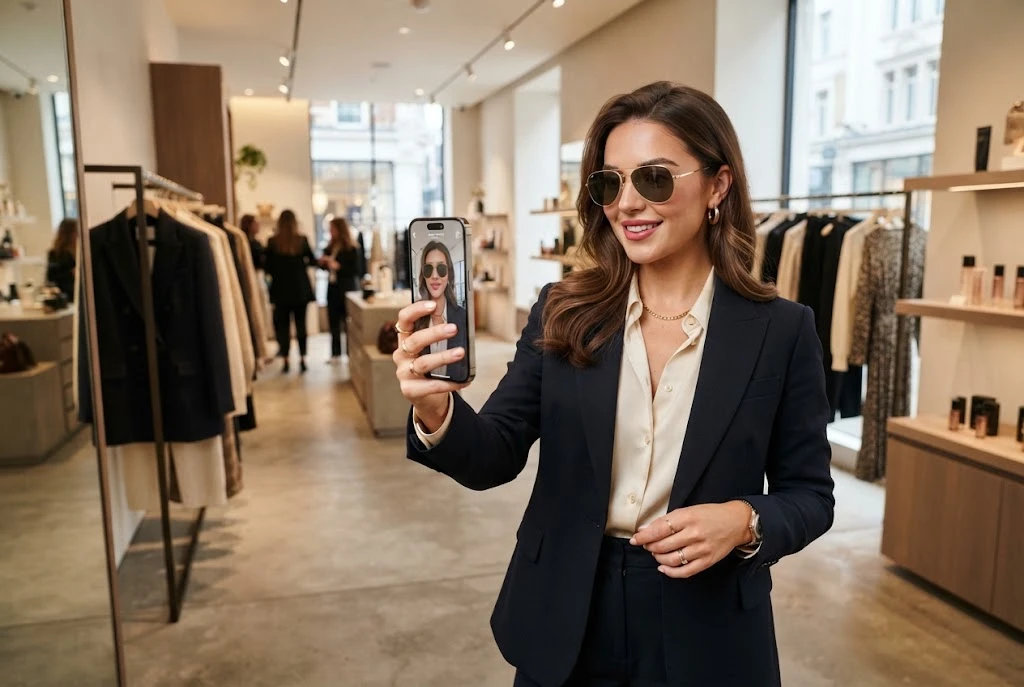
Augmented reality shopping is changing the way consumers experience products online by bringing digital items into real-world environments. Instead of relying only on product photographs and descriptions, shoppers can increasingly use their smartphones and other connected devices to visualise products, experiment with different styles and experience virtual try-on before making a purchase.
This shift is particularly relevant to fashion and beauty, where appearance, fit, colour and personal style can strongly influence buying decisions. AR can help reduce some of the uncertainty created by shopping online while making the journey more interactive.
In 2026, augmented reality is becoming part of a broader ecommerce technology landscape that also includes artificial intelligence, visual search, social commerce and personalised recommendations. The result is a more immersive approach to digital retail that attempts to bring some of the confidence of physical shopping into an online environment.
What Is Augmented Reality Shopping?
Augmented reality shopping uses digital technology to place virtual products or information into a view of the real world. A smartphone camera is one of the most common ways consumers access these experiences.
For example, a shopper might use their phone camera to see how a pair of glasses looks on their face. A beauty customer could preview a makeup shade, while a fashion shopper might use a virtual try-on tool to see how an item appears on their body.
AR differs from virtual reality because it does not completely replace the physical environment. Instead, digital content is layered over what the user can already see.
This makes AR particularly suitable for ecommerce. Consumers can remain in their home or another familiar environment while interacting with products digitally.
Why AR Fashion Shopping Is Growing
AR fashion shopping addresses one of the biggest limitations of buying clothing online: consumers cannot physically experience an item before purchasing it.
Traditional product photography can show colour, shape and styling, but it cannot always communicate how an item will look on a particular person. AR try-on can add another layer of visual information by allowing shoppers to preview products using their own image or camera feed.
For eyewear and accessories, this can be particularly intuitive. A shopper can compare frame shapes and colours against their own face rather than relying entirely on photographs of models.
For clothing, the experience is more technically demanding because garments need to be represented in relation to the user’s body. AI, computer vision and increasingly sophisticated 3D models can help create more realistic previews.
Shopify’s current ecommerce research identifies AR try-on and immersive shopping among the major fashion ecommerce trends for 2026.
AR Beauty Shopping Makes Product Testing More Interactive
AR beauty shopping can make cosmetics and appearance-related products easier to explore digitally.
Beauty shoppers often want to know how a particular lipstick, eyeshadow, blush or other product might look before purchasing it. A virtual experience can allow them to preview different colours using a phone camera.
This can be useful when a consumer is comparing several shades. Rather than opening multiple product pages and relying on static swatches, the shopper can interact with the products visually.
AR beauty experiences can also work alongside AI-powered recommendations. A system could potentially suggest products based on preferences and then allow the customer to preview selected options.
This creates a connection between discovery and experimentation. Instead of recommending a product and ending the journey there, technology can help the shopper visualise the recommendation before making a decision.
Virtual Try-On Is Becoming a Core Ecommerce Experience
Virtual try on is one of the most recognisable applications of AR in fashion and beauty.
A virtual try-on system can use a smartphone camera to identify facial or body features and then place a digital representation of a product into the image. More advanced systems can combine AR with AI and 3D modelling to create more realistic results.
Shopify describes modern virtual fitting rooms as a combination of AR, AI and 3D visualisation designed to simulate aspects of the in-store try-on experience.
The technology does not necessarily reproduce physical fitting perfectly. Fabric behaviour, lighting, body movement and garment construction can all affect the final result. Nevertheless, even an approximate visual preview can provide information that static product photography cannot.
How AR Shopping Technology Works
Behind a simple AR experience is a combination of hardware, software and product data.
The smartphone camera provides a view of the user’s surroundings or appearance. Computer vision can identify relevant surfaces, facial features or body landmarks. The AR system then positions a digital product within that environment.
Product assets are equally important. A retailer needs accurate digital representations of the items being displayed. These may include 3D models, product dimensions, colours, textures and other information.
AI can add another layer by helping systems understand images, estimate body positioning or generate more realistic product representations.
The quality of the final experience therefore depends on more than the AR software itself. Poor product data or inaccurate digital models can make an otherwise impressive technology feel unreliable.
Augmented Reality Fashion Can Improve Product Confidence
One of the strongest arguments for augmented reality fashion is that it can help consumers feel more confident before checkout.
Online shopping involves uncertainty. A customer may wonder whether a pair of glasses suits their face, whether a colour complements their appearance or whether an accessory works with an existing outfit.
AR cannot answer every question, but it can provide an additional visual reference. That can make the decision-making process more informed.
Shopify reports examples where AR and 3D product experiences have been used by fashion brands to increase engagement and purchase activity, although results vary by retailer, product category and implementation.
This distinction matters. AR should not be treated as an automatic conversion solution. Its effectiveness depends on whether the experience solves a genuine customer problem.
Immersive Shopping Goes Beyond Virtual Try-On
Immersive shopping is a broader concept than virtual try-on. It can include interactive 3D product views, AR product placement, virtual showrooms and other experiences that make ecommerce more visual and participatory.
A customer might rotate a product in three dimensions, explore details from different angles or place a digital item within their environment.
For fashion and beauty, this can create a stronger sense of product interaction. Instead of scrolling through a catalogue, customers can actively explore the product.
Shopify’s 2026 virtual shopping guidance describes ecommerce experiences increasingly combining AI, AR and live video to create more immersive digital journeys.
AR Ecommerce Can Connect Online and Offline Retail
AR ecommerce does not have to replace physical retail. In many cases, it can connect the online and offline experiences.
A shopper might use AR at home before visiting a store to narrow down their choices. Alternatively, a retailer could use an AR experience inside a physical location to provide additional product information or demonstrate options that are not physically available.
This creates an omnichannel journey where digital tools support physical shopping rather than competing with it.
For retailers, the opportunity is to make customer experiences more consistent across websites, mobile devices, stores and social platforms.
AR Can Work With AI Product Discovery
AR becomes even more useful when combined with artificial intelligence.
Imagine a shopper asking an AI assistant for sunglasses that match a particular style and budget. The system could recommend several options and then offer a virtual try-on experience.
The consumer would move from conversational discovery to visual evaluation without having to search manually through hundreds of products.
This connects directly with the broader future of fashion and beauty ecommerce, where AI shopping, personalisation, visual search and agentic commerce are becoming increasingly interconnected.
In this model, AR is not an isolated feature. It becomes one step within a more intelligent shopping journey.
Visual Search and AR Can Work Together
Visual search and AR can also complement one another.
A shopper might photograph an outfit they like and use visual search to find similar products. Once relevant products have been identified, AR could allow the shopper to see selected items on themselves.
This creates a complete visual journey:
- Discover an item through an image.
- Find visually similar products.
- Compare styles and colours.
- Use virtual try-on to preview selected products.
- Purchase through an ecommerce platform.
The process can make fashion discovery more intuitive because consumers do not need to know the exact words used to describe what they are looking for.
AR Shopping Can Support Social Commerce
Social platforms are another natural environment for AR experiences.
Fashion and beauty products are frequently discovered through creators, videos and visual content. If shoppers can move from social inspiration directly into an interactive product experience, the distance between discovery and purchase becomes smaller.
A creator could showcase a product and provide an AR experience that lets viewers explore how the item might look on themselves.
This connects social commerce with immersive shopping and gives consumers more control over product evaluation.
The opportunity is particularly strong for beauty because visual demonstration is already central to makeup, skincare and personal-style content.
AR Shopping Has Important Limitations
Despite its potential, AR is not a perfect substitute for physical shopping.
Virtual representations can differ from real products. Lighting can affect colour accuracy, while digital models may not perfectly represent fabric texture or physical fit.
Fashion shoppers may still want to feel a fabric before purchasing. Beauty customers may want to experience texture, fragrance or finish in person.
Technology can therefore reduce uncertainty without eliminating it completely.
Retailers should be honest about what their AR experience can and cannot show. Overpromising accuracy can damage trust if the physical product looks significantly different from the virtual preview.
Privacy Matters in AR Fashion and Beauty
AR experiences often depend on cameras, which makes privacy an important consideration.
A virtual try-on system may need access to a person’s face or body image to position a product accurately. Consumers should understand what information is processed and whether images are stored.
Retailers should provide clear privacy information and avoid collecting more information than is necessary for the experience.
Privacy can become even more important when AR is combined with AI, personalisation and customer accounts. A technology-rich shopping journey can be useful, but consumers should remain in control of their data.
Product Data Is the Foundation of Good AR
One of the less visible parts of AR ecommerce is product data.
A retailer may have a sophisticated AR interface, but the experience will still be limited if product dimensions, colours, variants and digital models are inaccurate.
Brands should therefore treat digital product assets as important ecommerce infrastructure.
High-quality 3D models, accurate imagery and structured product information can support multiple experiences at once, including AR, product pages, visual search and AI-powered shopping.
This means investment in AR can also encourage retailers to improve the quality of their broader digital catalogue.
How Fashion Brands Can Prepare for AR Ecommerce
Fashion brands do not necessarily need to create an elaborate virtual store immediately.
A practical starting point is to identify products where visualisation solves a clear customer problem. Eyewear, accessories, makeup and selected fashion products can be strong candidates because shoppers naturally want to understand appearance before purchasing.
Brands can then create accurate digital product assets and test how customers use the experience.
Usage metrics can help determine whether shoppers actually engage with AR and whether the experience influences product discovery, conversion or customer confidence.
Shopify recommends starting with digital assets for selected products, adding AR experiences to product pages and tracking engagement and conversion metrics rather than treating immersive technology as a standalone project.
The Role of AI in Future AR Shopping
The next generation of AR shopping will likely become more intelligent.
Instead of simply showing a product on a camera feed, AI could help consumers decide which products are worth trying. It could analyse preferences, previous interactions and visual information to narrow down options.
This could create a more efficient experience where customers do not have to try dozens of products individually.
AI could also improve the realism of virtual representations by helping simulate lighting, body positioning and other visual factors. However, consumers will still need clear expectations about the difference between a digital preview and the physical product.
AR Could Make Beauty Shopping More Experiential
Beauty is particularly well positioned for immersive technology because many products are judged by their visual effect.
Virtual makeup try-on can allow consumers to experiment with shades and combinations without physically applying products. This can make online discovery more playful while helping shoppers compare alternatives.
AR can also connect with beauty skin analysis technology. A customer could potentially receive personalised product suggestions and then use an AR experience to preview selected beauty products.
This combination could create a more complete digital consultation, although recommendations should remain transparent and should not be presented as medical advice unless supported by appropriate clinical validation.
AR Can Become Part of a Larger Fashion-Tech Ecosystem
Augmented reality should not be viewed as a standalone trend.
It is increasingly connected to AI, wearable technology, social commerce, visual search and personalised shopping. Smart glasses could eventually provide another way to access AR experiences without relying entirely on a smartphone screen.
This connects the topic with smart glasses fashion and wearable fashion technology, where fashion products increasingly become interfaces for digital experiences.
The long-term opportunity is therefore much broader than virtual try-on. Fashion and beauty could become more interactive across websites, physical stores, social platforms and wearable devices.
The Future of Augmented Reality Shopping
The future of augmented reality shopping will likely focus on usefulness rather than novelty.
Consumers do not necessarily want immersive technology for its own sake. They want better answers to practical questions: Does this suit me? What does this colour look like? How might this accessory fit my style? Which option should I choose?
AR can help answer some of those questions visually.
When combined with AI, visual search, social commerce and personalisation, AR can become part of a much more connected ecommerce journey. The customer can discover a product, understand it, experiment with it and purchase it through increasingly seamless digital experiences.
For fashion and beauty brands, this creates an opportunity to make ecommerce more interactive without abandoning the fundamentals of good retail. Accurate product information, transparent pricing, reliable delivery, strong customer service and straightforward returns will remain important.
Augmented reality shopping is therefore best viewed as a bridge between digital convenience and physical product experience. As the technology improves, that bridge could become one of the most useful parts of the modern fashion and beauty ecommerce journey.
