

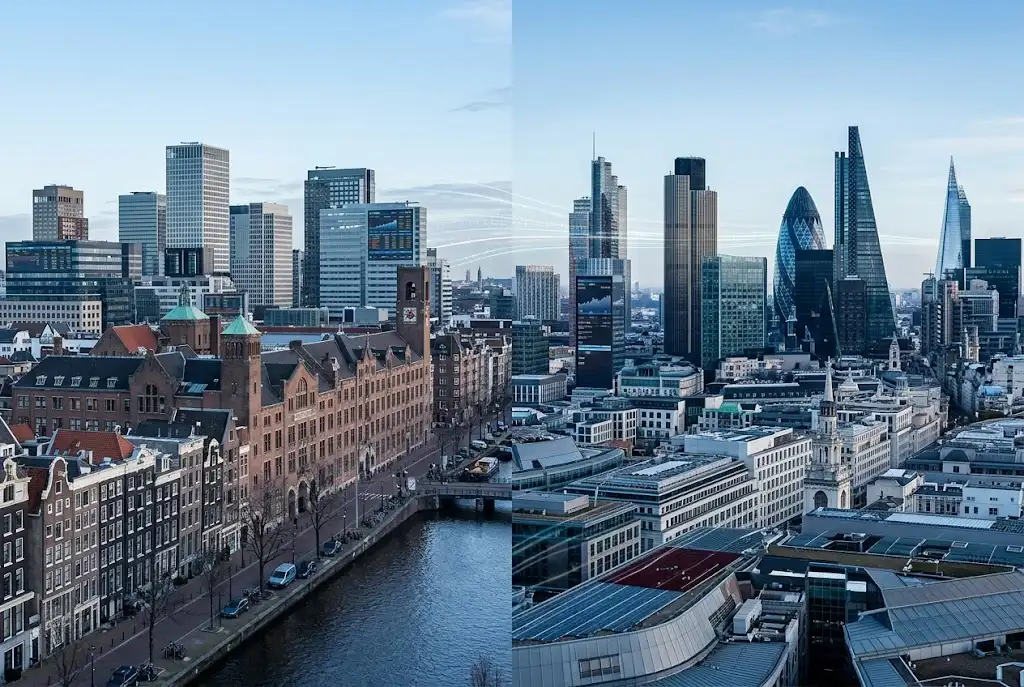
Amsterdam overtook London as Europe’s biggest share trading centre in January 2021, marking one of the clearest early signs of how Brexit changed the structure of European financial markets.
The shift happened immediately after the UK’s transition period ended and Britain left the European Union’s single market. New trading arrangements meant that a large amount of euro-denominated share activity moved from London to trading venues inside the EU.
According to Cboe data reported in February 2021, Amsterdam recorded average daily share trading of €9.2 billion during January, compared with €8.6 billion in London. The change was significant, but it did not mean that Amsterdam had replaced London as Europe’s overall financial centre.
What Happened to Share Trading After Brexit?
For decades, London had been one of the world’s most important financial centres and a major hub for European equity trading. Its position was supported by deep liquidity, international banks, investment firms, exchanges and financial infrastructure.
That changed when the Brexit transition period ended on 31 December 2020.
From the beginning of January 2021, EU rules concerning where certain euro-denominated shares should be traded became increasingly important. EU investors and trading firms moved significant portions of activity towards venues located inside the bloc.
Amsterdam was one of the main beneficiaries because several major trading platforms had already established or expanded operations there in preparation for Brexit.
Amsterdam’s Trading Volume Surged
The numbers published in February 2021 showed just how dramatic the initial change was.
Amsterdam had averaged around €2.6 billion in daily share trading during 2020. In January 2021, that figure increased to approximately €9.2 billion per day.
London moved in the opposite direction. Its average daily share trading volume fell from approximately €17.5 billion during 2020 to €8.6 billion in January 2021.
That placed Amsterdam narrowly ahead of London for the month.
The result was particularly striking because Amsterdam had ranked only sixth among European trading centres during 2020.
Why Did Trading Move to Amsterdam?
The main reason was not that traders suddenly decided Amsterdam was a better financial centre than London.
Brexit changed the regulatory framework governing access to European markets. Once the UK was outside the EU single market, firms had to adapt their trading arrangements to comply with European rules.
Trading venues had anticipated this possibility for several years. Cboe Europe and the London Stock Exchange’s Turquoise platform had established operations in Amsterdam before the end of the Brexit transition period.
This preparation allowed trading activity to move relatively quickly when the new rules took effect.
Why Were Euro-Denominated Shares Important?
Euro-denominated shares were particularly affected by the post-Brexit regulatory environment.
The EU wanted important euro financial activity to take place within jurisdictions where European authorities could exercise direct regulatory oversight.
As a result, a significant amount of trading in EU-listed shares that had previously taken place in London moved to venues within the European Economic Area.
The change was therefore less about investors abandoning London and more about where trades could legally and operationally be executed under the new regulatory arrangements.
More Than €6 Billion a Day Moved on the First Trading Day
The scale of the initial shift was already visible on 4 January 2021, the first major trading day after the transition period ended.
More than €6 billion of daily share trading moved from London towards EU-based platforms, according to contemporary reporting.
Trading continued without a major market disruption because financial firms had spent months preparing new European operations and redirecting order flows.
Amsterdam became one of the most visible beneficiaries of that preparation.
Cboe and Turquoise Helped Drive the Shift
Cboe Europe was an important part of Amsterdam’s rise.
The company had established an EU trading venue in Amsterdam before the end of the Brexit transition period. Its existing infrastructure meant that it could handle substantial volumes once EU share trading requirements changed.
Turquoise, a trading platform associated with the London Stock Exchange Group, also established an Amsterdam operation.
These platforms were important because the migration did not require the financial industry to build an entirely new trading ecosystem from scratch. Existing firms could redirect orders to venues they had already established inside the EU.
Did London Lose Its Position as a Financial Centre?
No. The January 2021 trading figures were significant, but they should not be interpreted as London losing its position as a major global financial centre.
Share trading represented only one part of London’s financial-services ecosystem.
The City remained home to major banks, asset managers, investment firms, exchanges, legal specialists, insurers and other financial businesses. Much of the activity serving UK clients also remained in London.
The immediate shift was therefore more accurately described as a redistribution of particular types of European trading activity rather than the collapse of London’s financial sector.
Why the Change Was Still Significant
Even if the direct economic effect of the share-trading migration was relatively limited compared with London’s overall financial industry, the symbolism was important.
London had spent decades building its position as a central marketplace for European investors. Within weeks of the UK’s final departure from the EU single market, another European city had overtaken it in average daily share-trading volume.
That made Amsterdam’s rise one of the clearest early examples of Brexit changing where financial-market activity was physically and legally conducted.
Amsterdam Also Gained Derivatives Trading
The movement was not limited to equities.
Contemporary market data also showed a significant change in euro-denominated interest-rate swaps trading.
Amsterdam and, to a lesser extent, Paris gained market share as some euro swaps activity moved away from London. London’s share of that particular market fell sharply during the same period.
Derivatives are important because they represent a much larger and more complex area of financial markets than ordinary share trading.
The changes therefore raised broader questions about whether Brexit could gradually redistribute other parts of London’s financial-services business.
What About EU Financial Services Equivalence?
One of the major issues after Brexit was the absence of a broad financial-services agreement giving UK firms the same automatic market access they had enjoyed while Britain was part of the EU framework.
Instead, the EU used its existing equivalence system in specific areas.
Equivalence is not a general financial-services passport. It is a mechanism through which the EU can recognise that a third country’s regulatory framework is sufficiently comparable for particular activities.
This became a major issue in discussions between London and Brussels because the UK wanted greater certainty for financial businesses while the EU wanted to retain regulatory control over access to its markets.
WebVibe’s related historical coverage examines how the EU approached UK-EU financial services equivalence and regulatory divergence in 2021.
Amsterdam Was Prepared for Brexit
Amsterdam’s success was not entirely unexpected.
After the UK’s 2016 referendum, financial-market operators began planning for several possible Brexit outcomes. Companies that needed an EU base established operations in cities such as Amsterdam, Paris, Frankfurt and Dublin.
Amsterdam had several advantages for share trading, including an established exchange environment and existing pan-European trading infrastructure.
That preparation allowed the Dutch capital to absorb a substantial amount of activity almost immediately after the transition period ended.
Why London Could Not Simply Keep All the Trading
London’s financial markets remained highly competitive, but market access depends on regulation as well as technology and liquidity.
Before Brexit, UK-based venues could serve EU investors within the framework of the EU single market. After the transition period, that automatic relationship changed.
Where EU rules required particular trading activity to take place within the bloc, London-based venues could not simply continue operating under the previous arrangement.
This is why some trading migrated even though London remained technologically capable of handling the transactions.
Was Amsterdam’s Rise Permanent?
The January 2021 result was initially described as a major post-Brexit shift, but it was too early at the time to know how the longer-term market would develop.
Some market participants expected London’s position to recover in certain areas, particularly where regulatory arrangements or the types of securities being traded changed.
However, the creation of new EU trading hubs meant that firms had already invested in alternative infrastructure.
The result was a more fragmented European trading landscape, with London remaining important while Amsterdam and other EU centres gained specific areas of activity.
What Did the Change Mean for Investors?
For ordinary investors, the shift was less dramatic than the headline suggested.
Investors could still buy and sell shares through brokers and investment platforms. The main change occurred behind the scenes, involving the location of trading venues, order books, regulatory obligations and market infrastructure.
Large institutional investors and trading firms were more directly affected because they needed to adjust their execution arrangements and relationships with European venues.
Retail investors were therefore unlikely to notice a simple change such as “London trading has moved to Amsterdam” when placing an ordinary investment order.
What Did Brexit Change for London’s Markets?
Brexit introduced a new division between London and the EU financial market.
London remained a major international financial centre, but its relationship with EU markets became dependent on specific regulatory arrangements rather than automatic single-market access.
This affected equities, derivatives, clearing, investment services and other parts of the financial ecosystem to varying degrees.
The Amsterdam episode was therefore important because it demonstrated how regulatory changes could influence the physical location of financial-market activity.
Amsterdam vs London: The January 2021 Numbers
| Measure | Amsterdam | London |
|---|---|---|
| Average daily share trading in 2020 | €2.6bn | €17.5bn |
| Average daily share trading in January 2021 | €9.2bn | €8.6bn |
| Position in January 2021 | Europe’s largest share-trading centre | Second-largest in the comparison |
The table illustrates why the January result attracted so much attention. Amsterdam’s daily volume more than tripled compared with its 2020 average, while London’s average fell by roughly half.
What Happened to Other European Financial Centres?
Amsterdam was not the only European city hoping to attract business from London.
Frankfurt, Paris, Dublin and other financial centres had also positioned themselves as potential beneficiaries of Brexit.
Different cities attracted different parts of the financial industry. Some were more competitive for banking, asset management, derivatives, trading infrastructure or corporate operations.
This meant Brexit did not simply produce a single replacement for London. Instead, financial activity became more distributed across several European centres.
Why the Amsterdam Story Still Matters
The Amsterdam-London trading shift remains a useful case study in how financial regulation can influence market structure.
Technology allows traders to operate across borders almost instantly, but regulation determines where certain types of trading can legally take place.
The January 2021 figures demonstrated that a change in market-access rules could redirect billions of euros of daily trading activity within a very short period.
For readers following financial markets today, the episode also provides useful background to the continuing debate over London’s relationship with European financial regulation.
Frequently Asked Questions
When did Amsterdam overtake London in share trading?
Amsterdam overtook London in January 2021, according to Cboe data published in February that year.
How much did Amsterdam trade in January 2021?
Amsterdam’s trading venues recorded average daily share trading of approximately €9.2 billion in January 2021.
How much did London trade?
London recorded approximately €8.6 billion in average daily share trading during the same month.
Why did share trading move from London to Amsterdam?
Brexit changed the UK’s relationship with the EU single market and regulatory framework. EU rules encouraged or required certain euro-denominated share trading to take place within EU venues, prompting trading firms and platforms to move activity.
Did Amsterdam replace London as Europe’s financial capital?
No. Amsterdam overtook London for average daily share-trading volume in January 2021, but London remained a much broader global financial centre with major banking, investment, insurance and market-infrastructure businesses.
Was the move caused entirely by Brexit?
Brexit was the principal regulatory catalyst for the January 2021 shift, although trading firms had already been preparing for different Brexit outcomes for several years.
Amsterdam’s Rise Was a Brexit Milestone
Amsterdam’s brief headline-making achievement in January 2021 captured the practical consequences of Brexit more clearly than many political debates could.
A city that had ranked sixth in European share trading during 2020 suddenly moved into first place, while London’s daily trading volume dropped substantially.
The change was driven largely by regulatory requirements and the relocation of trading infrastructure rather than by London losing all of its competitive advantages.
The episode therefore should be understood as a redistribution of European market activity. Amsterdam gained a significant share of euro-denominated trading, while London remained one of the world’s most important financial centres.
For more related financial-market coverage, readers can explore WebVibe’s guide to what traders expect from brokers and the site’s Business and Finance section.
Sources
This historical article uses contemporary Reuters reporting based on Cboe market data to explain the January 2021 trading shift following Brexit.
Reuters: Amsterdam displaces London as Europe’s top stocks centre after Brexit
