

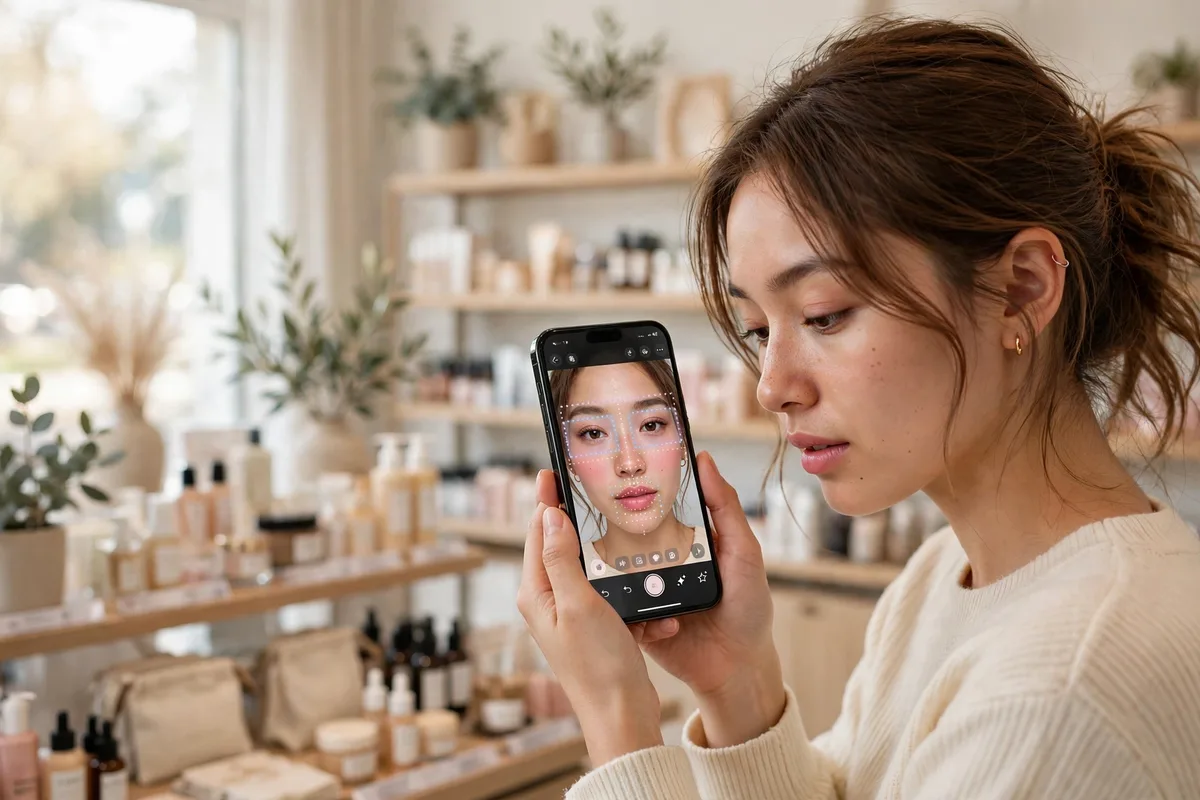
Choosing a foundation shade from a screen used to be guesswork. You would study swatch photos taken in someone else’s lighting, read a few reviews and hope for the best when the parcel arrived. Virtual try on beauty technology has changed that ritual. Using your phone camera and augmented reality, these tools map products onto your own face in real time, so you can see how a lipstick, blusher or foundation actually looks on your skin before you spend anything. For UK shoppers who increasingly buy beauty online rather than at a counter, that extra confidence matters.
What virtual try-on technology actually does
At its core, a virtual try-on combines facial mapping with augmented reality. The camera identifies the key points of your face — lips, eyes, cheekbones, jawline — and tracks them as you move. Software then applies a digital version of the product to the right area, adjusting for light and angle so the colour sits naturally rather than floating on top of the image. The best systems update dozens of times per second, which is why a virtual lipstick try on stays put when you smile or turn your head.
This is part of a wider shift in how technology is reshaping beauty retail, the same movement behind the growth of augmented reality shopping across fashion and cosmetics. What began as a novelty filter has matured into a serious retail tool that brands build into their own apps and websites.
Virtual makeup try-on: lipstick, foundation and more
Makeup is where the technology is most advanced. A virtual makeup try on can layer foundation, concealer, blusher, eyeshadow and lip colour in seconds, and most tools let you compare two shades side by side or save a look for later. An AI makeup try on goes a step further: instead of you hunting through a catalogue, the system studies your skin tone and features and suggests shades it thinks will suit you, much as a counter assistant would.
Foundation matching benefits most. Shade ranges are wide, returns are wasteful, and a wrong match is obvious the moment you step outside. Testing three or four shades virtually, in your own bathroom light, removes much of that risk. It also makes experimenting cheaper: the bold lip colour you would never test in a store becomes a ten-second decision at home.
How AR beauty improves the online shopping experience
AR beauty tools solve the central problem of online cosmetics: uncertainty. Browsing a product page gives you ingredients and marketing claims, but not the answer to the only question that matters — will this suit me? Augmented reality beauty features close that gap between browsing and the physical experience of a store counter.
Retailers have folded try-ons into the social side of shopping too. Our guide to live shopping for beauty and fashion shows how demonstrations and try-ons now happen in real time during streamed sales events, while TikTok Shop beauty has made product discovery and instant purchasing part of the same scroll. The try-on is no longer a separate destination; it is woven into wherever you already shop.
Virtual skincare consultations and skin analysis
Makeup is only half the story. A virtual skincare consultation typically starts with a selfie: the software analyses visible concerns such as dryness, uneven tone, blemishes and fine lines, then recommends a routine built from cleansers, serums and moisturisers. The underlying approach is the same one powering dedicated beauty skin analysis technology, which has become one of the fastest-growing areas of beauty tech.
Used well, these consultations are genuinely useful. They encourage consistency, help you avoid layering incompatible active ingredients, and can track visible changes over weeks of use. They are not a substitute for a dermatologist — no selfie scan can diagnose a medical condition — but as a guide to building a sensible daily routine, they are far better than buying whatever happens to be trending.
Virtual fitting rooms and fashion try-on
The same principles are spreading beyond cosmetics. A virtual fashion try on lets you see how a dress, jacket or pair of glasses might look on your body shape, and the virtual fitting room concept now extends to entering measurements or a short body scan so software can recommend sizes as well as styles. Sizing is the biggest cause of fashion returns, so even modest improvements in accuracy have a real effect on cost and waste.
Progress in fashion is slower than in makeup — fabric drape and fit are harder to simulate than lip colour — but the direction is clear, and it forms part of the broader picture we explored in the future of fashion and beauty ecommerce. Expect try-on features to become a standard expectation rather than a special feature within a few product cycles.
The limits: accuracy, trust and privacy
Honesty matters here. Screen colour varies, bathroom lighting is unflattering, and a digital swatch can still differ from the physical product on your skin. Treat a try-on as a strong shortlisting tool, not a guarantee, and check a shade in natural light where you can.
Privacy deserves a thought as well. A face scan is personal data. Reputable tools process images on your device or delete them after the session, and UK data protection law gives you rights over how your images are used. Before using any try-on, it is worth a quick look at what the brand says it does with your photos — and being cautious with unknown apps that ask for camera access without a clear reason.
How to get the most from a virtual try-on
A few habits make the results noticeably more reliable. Start with a clean, makeup-free face in natural daylight, facing a window rather than a lamp. Hold the phone at eye level and keep your hair off your face. Test shades you are genuinely considering rather than the whole catalogue, and screenshot your favourites so you can compare them later, ideally next to a photo of a product you already own and like. Finally, remember that virtual try on beauty tools work best as the last step before buying — after you have read the ingredients, checked the finish and narrowed the shade range — rather than as a replacement for that homework.
