

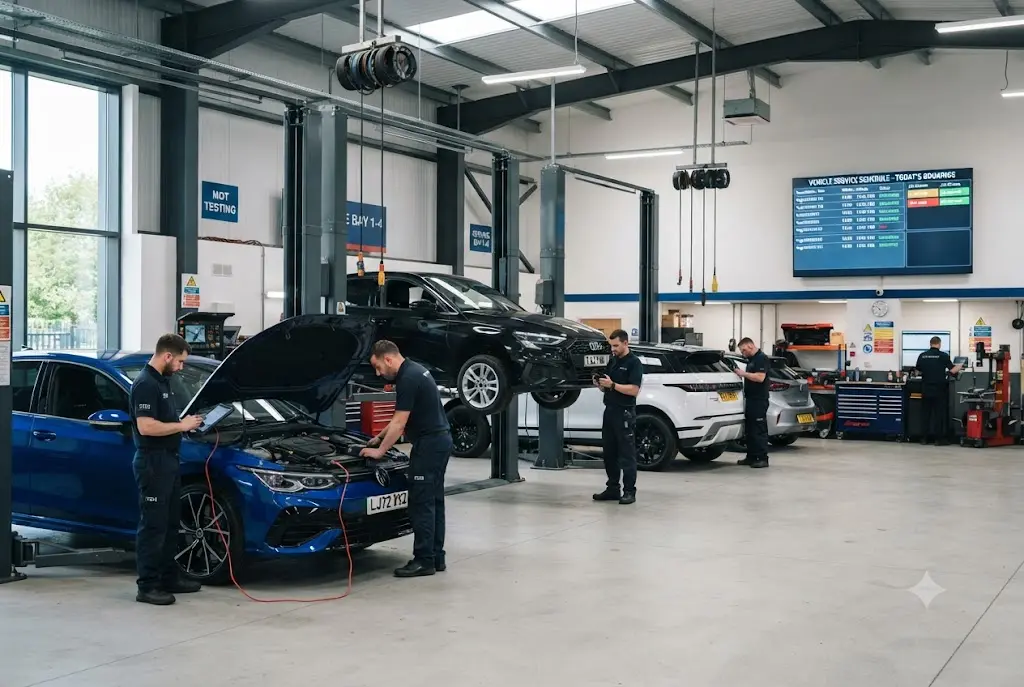
Garage chains are changing how motorists in the UK find, book and manage vehicle maintenance. Traditional workshops remain important, but larger automotive networks are increasingly combining physical garages with online booking, digital vehicle information, electronic diagnostics and connected customer services. This shift is creating a new generation of digital garage networks that make routine vehicle care more convenient while helping businesses manage increasingly complex vehicles.
For drivers, the change is visible in simple features such as online service bookings, registration-based vehicle searches, digital quotes and appointment reminders. Behind those features, however, garage chains are also adopting technologies that support workshop scheduling, diagnostics, parts management and customer communication.
This development matters because the UK automotive aftermarket is becoming more technologically demanding. Modern petrol and diesel cars contain sophisticated electronic systems, while hybrid and electric vehicles introduce additional diagnostic and maintenance requirements. As a result, successful garage networks increasingly need both physical expertise and digital capability.
Why Garage Chains Are Becoming More Digital
Garage chains have traditionally competed through location, price, service availability and technician expertise. Those factors still matter, but the customer journey now often begins before a vehicle reaches the workshop.
A motorist may search for a local service centre, enter a registration number, compare available services, choose an appointment and receive confirmation without making a phone call. For a large network, managing that process efficiently requires connected systems across websites, booking platforms and individual workshops.
Digital tools can also reduce administrative work. Instead of relying entirely on manual telephone bookings and paper-based records, a garage business can use technology to organise appointments, capture customer information and give workshop teams a clearer view of upcoming work.
The result is a more connected model of vehicle servicing. The physical garage remains at the centre of the service, but digital systems increasingly influence what happens before, during and after the visit.
What Makes a Digital Garage Network Different?
A digital garage network is more than a group of workshops with a website. The defining feature is the connection between customer-facing technology and operational systems.
A well-developed network may combine online booking, vehicle identification, workshop scheduling, customer communication, electronic diagnostics and service records. These functions can work together to create a smoother journey from the first search through to completed repairs.
Online booking and vehicle identification
Online booking is one of the most visible parts of the digital garage experience. Customers can often provide their registration and postcode, select a required service and find an available location.
This approach can make booking easier because motorists do not necessarily need to explain their vehicle details over the telephone. The registration can help identify the vehicle, while the booking system can present services relevant to the customer’s requirements.
Connected workshop operations
For the garage itself, digital scheduling can help organise technician availability, service bays and appointment times. When customer bookings are connected to workshop operations, staff can have better visibility of the day’s workload.
This becomes particularly valuable for large garage chains operating multiple locations. A consistent digital process can help maintain a common customer experience while individual workshops continue to handle local vehicle requirements.
Digital diagnostics
Modern vehicles rely heavily on electronic control systems. Diagnostic equipment therefore plays an increasingly important role in vehicle servicing and repair.
Digital diagnostic tools can help technicians identify electronic faults and investigate warning lights more efficiently. As vehicle technology develops, garage chains need equipment and technicians capable of working across a broad range of makes, models and powertrains.
Major Garage Chains in the UK
The UK aftermarket includes several established automotive networks with different service models. Some concentrate strongly on tyres and fast-fit maintenance, while others provide broader servicing, mechanical repairs, accident repair or specialist services.
National Tyres & Autocare is associated with a large network focused on tyres, servicing, MOT and vehicle maintenance. Its network model illustrates how motorists can access automotive services through multiple physical locations while interacting with a centralised brand.
Kwik Fit is another prominent name in the UK automotive service market. Its official service information shows that the business offers tyres, MOT testing, servicing, brakes, exhausts, batteries, air conditioning and other vehicle services. It also provides online booking functionality, demonstrating how digital customer journeys can sit alongside a nationwide physical network.
ATS Euromaster has a long-standing presence in tyre and automotive services, while Halfords Autocentres provides servicing and maintenance through the wider Halfords automotive business.
Protyre is another established network covering tyres, MOT and vehicle servicing. Meanwhile, Fix Auto operates through a network model focused primarily on accident and body repair rather than the same fast-fit proposition as traditional tyre and servicing chains. Fix Auto UK describes its network as providing accident repair and related body repair services.
Fast Fit Autocentres represents another example of the independent and networked automotive service model, showing that the digital transformation of vehicle maintenance is not limited to the largest national brands.
How Digital Technology Improves the Customer Experience
Convenience is one of the biggest advantages of digital garage services. Motorists increasingly expect to complete routine tasks online, and vehicle maintenance is no exception.
A strong digital journey can allow a customer to search for a nearby centre, select a service, choose an appointment and receive confirmation with minimal friction. Online booking can also make garage availability easier to understand.
Digital communication can continue after the booking. Customers may receive appointment confirmations, reminders, inspection updates or information about additional work. Clear communication can help reduce uncertainty, particularly when a repair takes longer than initially expected.
For larger networks, consistency is another advantage. A centralised digital platform can help standardise the way customers interact with different branches, even though the actual repair work is performed locally.
Garage Chains and the Growth of Automotive Software
The digital transformation of garage chains is closely connected to automotive software. Behind an online booking form or customer dashboard, workshops may rely on systems for scheduling, customer records, job management, invoicing, stock control and reporting.
For independent garages and larger networks alike, choosing the right technology can make daily operations easier to coordinate. Businesses looking to understand this side of the industry can explore our guide to automotive software, which covers the wider role of workshop software and digital garage management.
Cloud-based systems can be particularly useful for businesses operating across multiple locations. Centralised access can make it easier for management teams to monitor activity while allowing individual workshops to handle day-to-day jobs.
However, software should support technicians rather than create additional administrative complexity. The best systems are designed around practical workshop workflows, with clear interfaces and reliable access to the information staff actually need.
Garage Chains Need to Prepare for Hybrid and Electric Vehicles
The changing vehicle parc is another reason digital capability matters. Hybrid and electric vehicles require technicians to understand systems that differ significantly from conventional petrol and diesel powertrains.
Hybrid vehicles combine an internal combustion engine with electric propulsion and battery systems. Their maintenance can therefore involve high-voltage components, electronic control systems and specialised diagnostic procedures.
Garage chains that want to serve this growing segment need appropriate equipment, technician training and reliable processes. Our related guide to hybrid servicing explores the technology and maintenance considerations behind modern hybrid vehicles.
Electric vehicles create another layer of change. EV servicing can involve battery systems, electric motors, thermal management, charging components and software-driven vehicle functions. As more vehicles depend on connected electronic systems, digital capability becomes increasingly important to the aftermarket.
Businesses planning for this transition can also explore our article on EV servicing to understand how workshop requirements are changing.
Digital Wheel Alignment Is Another Area of Change
Digitalisation is not limited to booking and customer management. Workshop equipment itself is becoming increasingly sophisticated.
Wheel alignment is a good example. Modern alignment equipment can use sensors, cameras or electronic measurement systems to help technicians assess wheel geometry. Accurate measurements can help identify alignment problems that may contribute to uneven tyre wear, steering issues or handling concerns.
For garage chains, digital wheel alignment can also support consistent processes between branches. When equipment and procedures are standardised, technicians can work from measurable data rather than relying solely on traditional manual methods.
Our guide to wheel alignment looks more closely at digital alignment, wheel tracking, sensors and related workshop technology.
What Garage Chains Should Look for in Digital Systems
Not every digital system will suit every automotive business. Garage chains should consider how technology fits into their existing operations rather than adopting software simply because it has a long list of features.
Ease of use
Workshop teams need systems that are practical during busy working days. Complicated interfaces can slow down staff and reduce adoption. Clear workflows and accessible information are often more valuable than unnecessary features.
Integration
Digital platforms become more useful when different functions can communicate. Booking, job management, customer records, parts information and invoicing should ideally work together rather than creating isolated data silos.
Scalability
A system suitable for one workshop may not be appropriate for a network with dozens or hundreds of locations. Garage chains should consider whether their technology can support additional sites, users, services and vehicle types as the business grows.
Data security
Customer and vehicle information needs appropriate protection. Businesses should consider access controls, data handling practices, backups and system security when selecting digital platforms.
The Future of Digital Garage Networks
The future of garage chains is likely to involve an even closer relationship between physical workshops and digital services. Customers will continue to expect convenient booking and communication, while technicians will increasingly depend on electronic diagnostic information and connected workshop equipment.
Artificial intelligence, connected vehicles and increasingly software-defined vehicle systems may introduce further changes. However, technology will not eliminate the importance of skilled technicians. Instead, digital tools are likely to become an extension of their expertise.
For garage networks, the strongest strategy is therefore not simply to digitise individual tasks. It is to create a connected service experience in which customers, technicians, workshop equipment and business systems can work together.
Why Digital Capability Matters for UK Garage Chains
Garage chains operate in a competitive market where convenience, technical capability and customer trust all influence buying decisions. Digital technology can strengthen each of these areas when it is implemented thoughtfully.
For motorists, the benefits can include easier booking, clearer communication and access to modern diagnostic and maintenance services. For workshops, connected systems can improve organisation, visibility and operational efficiency.
As hybrid and electric vehicles become a more important part of the UK vehicle market, digital competence will become even more significant. Garage chains that combine experienced technicians with capable software, diagnostic equipment and customer-facing platforms will be better positioned to meet the changing expectations of modern motorists.
The digital garage network is therefore not simply a trend in online booking. It represents a broader transformation in how vehicle maintenance is delivered, managed and experienced across the UK automotive aftermarket.
