

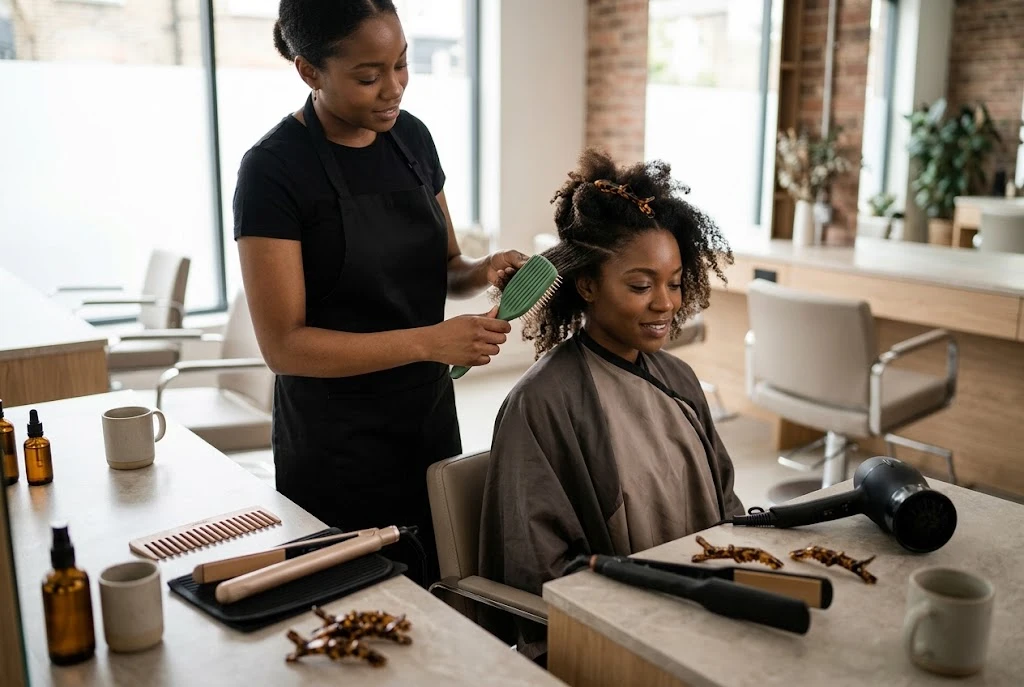
This guide explores how to approach multi-cultural hair care and styling, including choosing suitable combs and brushes, managing heat, controlling tension, working in sections and adapting techniques to different textures.
Understanding Different Hair Textures
Hair texture is often described using broad categories such as straight, wavy, curly and coily. These categories can provide a useful starting point, but they do not tell the whole story. Two people with a similar curl pattern can have very different hair density, strand thickness, porosity and levels of damage.
- Straight hair: Usually has little or no visible curl, although thickness and density can vary considerably.
- Wavy hair: Often forms an S-shaped pattern and can range from loose waves to more defined textures.
- Curly hair: Forms visible curls or loops, with considerable variation in curl size and density.
- Coily hair: Contains tightly coiled or spring-like patterns and may require particularly careful handling to minimise dryness and breakage.
Afro-textured hair can require a particularly thoughtful approach to detangling, moisture and manipulation. Its tightly curled structure can make it more susceptible to dryness and breakage when handled aggressively, so tool selection should always take the condition of the individual hair into account.
Choosing the Right Hair Tools
The most expensive or powerful tool is not automatically the best option. A suitable tool should provide enough control for the texture, density and condition of the hair without creating unnecessary tension or heat.
Combs and Detangling Tools
Wide-tooth combs are often useful for detangling textured hair because the wider spacing can help reduce unnecessary pulling. Flexible detangling brushes can also be useful when they are appropriate for the hair’s condition and are used gently.
Rather than trying to pull a comb through the entire head at once, divide the hair into manageable sections. Begin at the ends and gradually work towards the roots. If resistance is excessive, stop and separate the section further rather than increasing force.
Brushes for Smoothing
Paddle brushes can work well for certain straight and wavy hair types, while curl-focused brushes can help define particular curly patterns. For textured hair, however, the objective should be controlled handling rather than simply creating maximum tension.
Brush selection can also depend on whether the objective is detangling, smoothing, blow-drying, defining curls or finishing a style. Keeping several appropriate tools available gives the stylist greater flexibility during a consultation.
Hair Dryers and Diffusers
A hair dryer with adjustable temperature and airflow provides more control than a device with one consistently high setting. A diffuser can distribute airflow more gently across curly or coily hair and may help maintain the natural pattern during drying.
Heat should not be used simply to make the styling process faster. Controlled airflow, suitable sectioning and the lowest effective temperature can help reduce unnecessary stress on the hair.
Managing Heat Safely
Heat styling should be adapted to the condition of the hair rather than applying one temperature setting to every client. Fine, damaged, dry or chemically treated hair may require greater caution than healthy, dense hair.
Instead of assuming that higher temperatures produce better results, focus on preparation, sectioning and controlled movement. Flat irons, curling tools and heated brushes can expose the hair to substantial heat, so repeated use should be approached carefully.
Heat tools should also be handled safely around the scalp and hairline. Allow heated equipment to cool safely after use and follow the manufacturer’s instructions for operation, storage and maintenance.
Working with Afro-Textured and Coily Hair
Afro-textured hair can benefit from a particularly considered approach to moisture, detangling and manipulation. The British Association of Dermatologists notes that the tightly curled structure can make it harder for natural oils from the scalp to travel along the hair shaft, which can contribute to dryness and breakage.
Prepare the Hair Before Styling
Before using styling tools, assess the condition of the hair and prepare it appropriately. Detangle gently, divide the hair into manageable sections and consider previous chemical treatments, colouring and heat exposure.
A routine may include cleansing, conditioning, careful detangling, gentle drying and appropriate moisturising. The exact routine should be adapted to the individual’s hair and scalp rather than applying a universal method.
Use Controlled Sectioning
Sectioning is particularly useful when working with dense or tightly coiled hair. Smaller sections can give the stylist better control and make it easier to distribute tension consistently.
Sectioning clips should hold hair securely without snagging. If a section becomes difficult to manage, reducing its size is generally more sensible than increasing pulling force.
Avoid Excessive Tension
Tension can help create a smooth finish, but excessive pulling can contribute to breakage and traction-related hair loss. Extra care should be taken around the hairline and other areas that may already be fragile.
Braids, twists, wigs and extensions can provide versatile styling options, but they still need to be installed and maintained carefully. Tight styles and prolonged tension can place additional stress on the hair and scalp.
Techniques for Wavy and Curly Hair
Wavy and curly hair often responds well to techniques that preserve its natural pattern rather than repeatedly brushing or stretching it into a completely different shape.
- Choose section sizes according to the density of the hair.
- Detangle gently to minimise unnecessary breakage.
- Use a diffuser when appropriate for the desired finish.
- Avoid excessive brushing once the curl pattern has been established.
- Use controlled tension when temporarily straightening curly hair.
- Monitor how the hair responds instead of repeatedly applying heat.
The objective is to work with the natural characteristics of the hair while maintaining enough control to achieve the client’s desired result.
Moisture and Product Selection
Tool selection should not be considered separately from preparation. A high-quality styling tool cannot compensate for hair that is already excessively dry, tangled or weakened.
Conditioners, leave-in products, styling creams and other preparations can behave differently depending on the individual’s hair characteristics. Product selection should therefore be based on the condition of the hair, scalp needs, styling objective and existing routine.
For Afro-textured hair, gentle handling and appropriate moisturising can be particularly important. The British Association of Dermatologists recommends taking steps to reduce excessive manipulation and avoid practices that can contribute to hair damage.
How Technology Is Changing Beauty and Haircare
Modern beauty technology is also changing how consumers understand and manage their appearance. Digital consultations, imaging systems and skin-analysis technologies can help beauty professionals gather additional information before recommending treatments or routines.
For a broader look at how technology is influencing personalised beauty services, see our guide to beauty skin analysis technology. Although skin analysis and hair styling involve different areas of beauty care, both demonstrate the growing importance of personalised approaches rather than one-size-fits-all recommendations.
Maintaining Hair Styling Tools
Professional styling equipment needs regular cleaning and maintenance regardless of the texture being treated. Hair, oils and product residue can accumulate on brushes, combs and heated surfaces, affecting performance and hygiene.
- Clean brushes and combs regularly.
- Remove product build-up from heated styling surfaces.
- Inspect electrical cords and plugs for visible damage.
- Store equipment safely when it is not being used.
- Follow the manufacturer’s maintenance instructions.
- Replace damaged tools rather than continuing to use them.
Clippers and trimmers should also be cleaned and maintained appropriately. Professional equipment should be selected according to the service being provided rather than simply its power or appearance.
Building a Better Hair Consultation
Technical ability is only one part of effective multi-cultural hair styling. A proper consultation helps the stylist understand the client’s routine, previous treatments, preferred styles and concerns before selecting tools or techniques.
Useful consultation questions may include:
- Has the hair been chemically treated or coloured?
- Is there existing breakage, dryness or excessive shedding?
- How does the client normally detangle their hair?
- How frequently are heat tools used at home?
- Does the client regularly wear braids, twists, wigs or extensions?
- Are there areas of the scalp or hairline that feel particularly fragile?
- What result does the client want from the appointment?
Explaining why a particular comb, brush, dryer or heat technique has been selected can also make the consultation more transparent and personalised.
Common Mistakes to Avoid
Working confidently with different hair textures does not necessarily mean buying completely different equipment for every client. It means knowing when and how to adapt the equipment already available.
Common mistakes include:
- Using the same heat setting for every hair type.
- Detangling aggressively when hair is difficult to separate.
- Applying excessive tension to achieve a faster result.
- Using heat repeatedly on weakened or chemically treated hair.
- Ignoring the condition of the hairline and scalp.
- Assuming curl pattern alone determines the correct technique.
- Failing to clean and maintain styling equipment.
A better approach is to assess the hair first, select an appropriate tool and adjust the technique according to how the hair responds.
Developing More Inclusive Haircare Skills
Hair professionals can improve their confidence by continuing to learn about different textures, styling methods and potential sources of damage. Practical education is particularly valuable because working effectively with different textures requires more than simply understanding terminology.
UK salons can benefit from training that covers consultation, detangling, product selection, heat management, protective styling, sectioning and techniques for recognising when a particular method should be modified or avoided.
Inclusive haircare is ultimately about adapting professional practice to the individual rather than expecting every client to fit the same styling process.
Frequently Asked Questions
What is the best hair tool for all hair types?
There is no single tool that is ideal for every hair type. A selection of appropriate combs, brushes and adjustable styling equipment provides greater flexibility across different textures and styling requirements.
Is high heat better for thick or coily hair?
Not necessarily. Thick or coily hair may require careful sectioning and controlled styling, but increasing the temperature is not automatically safer or more effective. Use the lowest effective heat for the desired result.
How should Afro-textured hair be detangled?
Detangle gently in manageable sections using a wide-tooth comb or another suitable detangling tool. Avoid forcing a comb through knots because excessive pulling can contribute to breakage.
Can frequent heat styling damage textured hair?
Yes. Excessive heat can weaken and dry the hair, increasing its susceptibility to breakage. Heat should therefore be controlled and adapted to the condition of the hair.
How often should hair styling tools be cleaned?
The appropriate frequency depends on the tool and how often it is used, but brushes, combs and heated surfaces should not be allowed to accumulate significant hair or product residue. Professional equipment should form part of the salon’s regular cleaning and maintenance routine.
Final Thoughts
Mastering multi-cultural hair styling is less about finding one perfect tool and more about understanding how to adapt equipment and technique to the individual. Texture, density, condition, previous treatments and styling goals should all influence the approach.
By combining careful consultation, appropriate tools, controlled heat, gentle detangling, sensible tension and ongoing professional education, stylists can work more confidently across diverse hair textures while keeping hair and scalp care at the centre of the service.
For additional professional guidance, consult the British Association of Dermatologists guidance on caring for Afro-textured hair.
