

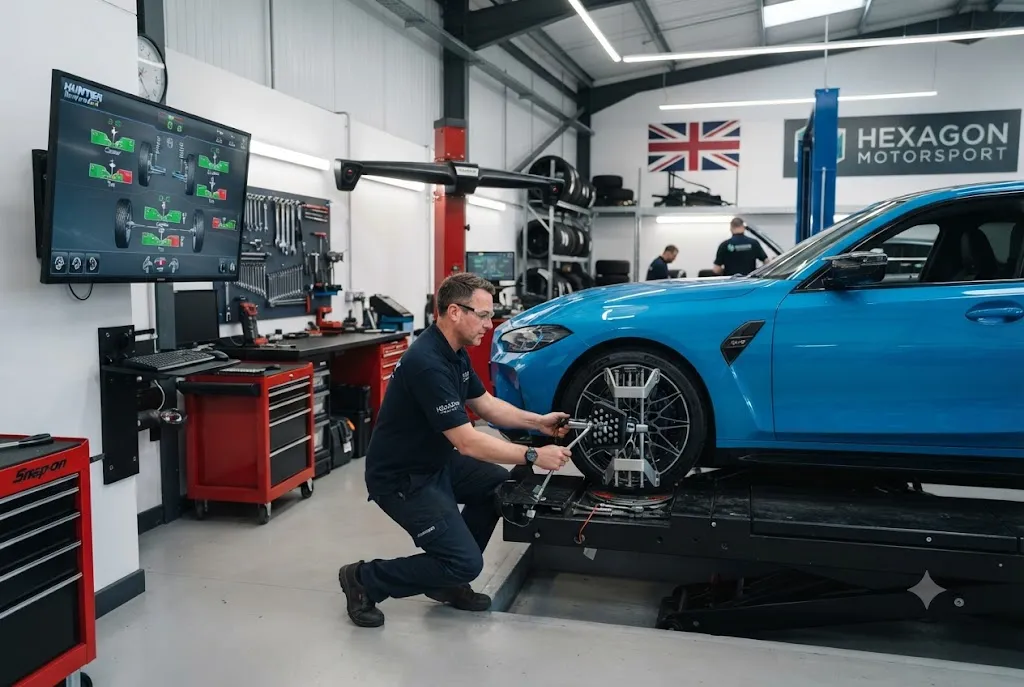
Wheel alignment is an important part of vehicle maintenance because the position of a vehicle’s wheels can affect handling, tyre wear and driving stability. Modern workshops increasingly use digital equipment, alignment sensors and computerised measurement systems to check wheel geometry more accurately than traditional visual methods alone.
For UK motorists, alignment problems can develop after hitting potholes, kerbs or other road hazards. They can also become noticeable through uneven tyre wear, an off-centre steering wheel or a vehicle that pulls to one side. Identifying these symptoms early can help prevent unnecessary tyre wear and address potential handling problems.
Technology has also changed the way garages perform alignment checks. Laser wheel alignment equipment, digital sensors and alignment software can give technicians detailed measurements and manufacturer-specific targets. This makes wheel tracking a much more data-driven process than it once was.
What Is Wheel Alignment?
Wheel alignment is the process of measuring and, where adjustment is possible, correcting the angles of a vehicle’s wheels so they are positioned according to the manufacturer’s specifications.
Alignment is often referred to as tracking, particularly when discussing the direction in which the wheels point. However, a complete alignment assessment can involve several geometry measurements.
Three commonly discussed alignment angles are camber, caster and toe. The exact adjustment possibilities depend on the vehicle’s suspension design.
Camber
Camber describes the inward or outward tilt of a wheel when viewed from the front of the vehicle. Incorrect camber can contribute to uneven tyre wear and may affect handling.
Caster
Caster relates to the angle of the steering axis when viewed from the side. It contributes to steering behaviour, stability and the way the steering wheel returns after a turn.
Toe
Toe describes the direction in which the wheels point relative to each other when viewed from above. Toe-in and toe-out refer to the relative positions of the front edges of the tyres.
RAC guidance explains that proper wheel alignment involves adjusting key angles including camber, caster and toe, while noting that incorrect alignment can contribute to uneven tyre wear and handling issues.
Why Wheel Alignment Matters
Correct wheel alignment helps a vehicle maintain predictable handling and can reduce unnecessary tyre wear. When wheels are not correctly aligned, tyres may scrub against the road rather than rolling in the intended direction.
The UK’s Highway Code also highlights the connection between uneven tyre wear and possible problems with braking, suspension or wheels being out of alignment. It advises that such faults should be corrected promptly.
Alignment is therefore not simply a cosmetic adjustment. It forms part of maintaining a vehicle’s steering, tyre and suspension condition.
For businesses managing multiple vehicles, regular checks can also help identify recurring wear patterns. This can be particularly relevant for fleets that cover high mileages or operate frequently on roads where potholes and uneven surfaces are common.
Signs That Your Vehicle May Need Wheel Alignment
Alignment problems are not always immediately obvious. However, several symptoms can indicate that a vehicle should be inspected.
Uneven tyre wear
Uneven wear across the tyre tread can be a warning sign. If one edge of a tyre is wearing faster than the other, alignment or suspension condition may need investigation.
Tyre pressure, suspension faults and other mechanical issues can also cause uneven wear, so the correct diagnosis requires a proper inspection rather than assuming alignment is the only possible cause.
Vehicle pulling to one side
If a vehicle consistently drifts or pulls to one side on a suitable straight road, alignment may be one possible cause. However, tyre pressures, tyre condition, road camber and other mechanical factors can also influence vehicle direction.
Off-centre steering wheel
A steering wheel that remains noticeably off-centre while the vehicle travels straight can indicate a geometry issue. It is worth having the vehicle inspected rather than attempting to correct the steering wheel position independently.
Unusual handling
Changes in steering response or the way a vehicle behaves through corners can justify an inspection. Alignment is only one part of the vehicle’s steering and suspension system, so technicians should consider the wider mechanical condition.
When Should You Have Wheel Alignment Checked?
There is no single interval that applies to every vehicle. Instead, alignment checks can be particularly useful when a vehicle shows symptoms or after an event that could affect wheel geometry.
Drivers should consider an inspection after:
- Hitting a significant pothole or kerb.
- Experiencing unusual steering behaviour.
- Replacing suspension or steering components.
- Noticing uneven or rapid tyre wear.
- Fitting new tyres when existing wear suggests a geometry issue.
- Carrying out repairs that could alter suspension geometry.
The manufacturer’s maintenance information and advice from a qualified technician should guide the appropriate inspection schedule for a specific vehicle.
How Laser Wheel Alignment Works
Laser wheel alignment uses laser-based measuring equipment to help determine wheel and suspension geometry. The equipment is positioned on the vehicle’s wheels, and the system measures their relative positions.
Laser technology can provide a visual and measurable reference for technicians. Depending on the equipment, measurements can be compared with target values to determine whether adjustments are required.
Laser wheel alignment remains useful because it provides technicians with measurement data rather than requiring them to rely solely on visual assessment.
Some workshops combine laser measurement with computerised systems that display alignment results on a monitor. This can make it easier to identify measurements outside the recommended range.
Digital Wheel Alignment and Alignment Sensors
Modern alignment systems can use electronic alignment sensors to measure wheel angles and vehicle geometry. Sensors are mounted to the wheels or appropriate measurement points, depending on the equipment and alignment system.
The sensor data can then be processed by alignment software. Instead of technicians manually interpreting every measurement, the system can present readings alongside target specifications.
This is particularly useful in busy workshops because technicians can see the relationship between measured values and the manufacturer’s recommended ranges.
Electronic wheel alignment equipment is also an established category of automotive testing technology. UK Intellectual Property Office records, for example, include electronic devices for measuring wheel alignment and related vehicle diagnostic and measurement equipment.
Alignment Software Makes Workshop Measurements Smarter
Alignment software is an important part of the modern digital wheel-alignment process. The software can take measurements from sensors and present them in a format that helps technicians understand the vehicle’s geometry.
Depending on the system, software may provide vehicle-specific specifications, before-and-after measurements and adjustment guidance. This can make the alignment process more structured and easier to document.
Digital records can also benefit customers. A workshop may be able to show measured values before and after adjustments, making the service easier to understand.
For businesses already investing in automotive software, alignment data can form part of a broader digital workshop workflow. The aim is to connect technical measurements with job records, customer information and service documentation.
Wheel Tracking vs Full Alignment
Wheel tracking is often used as a general term for checking and correcting wheel direction. In everyday workshop conversations, customers may hear phrases such as tracking or four-wheel alignment.
A full alignment assessment can involve more than simply adjusting the front wheels. Depending on the vehicle, technicians may need to assess the relationship between front and rear wheel geometry and the vehicle’s overall alignment.
The appropriate procedure depends on the vehicle’s suspension design and the adjustment options provided by the manufacturer.
This is why a professional workshop should inspect the vehicle before recommending a particular alignment service.
Digital Balancing and Wheel Alignment Are Different
Digital balancing and wheel alignment are related wheel-and-tyre services, but they address different problems.
Wheel balancing focuses on distributing the wheel and tyre assembly’s mass appropriately around its rotation. Alignment focuses on the geometric position and angles of the wheels.
A vehicle can therefore have balanced wheels but incorrect alignment, or correct alignment but a wheel balance problem. Vibrations, uneven wear and handling complaints may require different diagnostic approaches.
A workshop should identify the underlying issue instead of assuming every steering or tyre symptom requires the same service.
How Smart Alignment Helps Modern Workshops
Smart alignment systems can improve consistency by combining sensors, digital measurements, software and vehicle-specific specifications.
For workshop managers, this can help standardise the alignment process between technicians. Instead of relying entirely on individual interpretation, staff can work from measurable information provided by the equipment.
Digital systems can also help create a record of the service. Before-and-after measurements may provide useful evidence of what was found and what adjustments were made.
This can be particularly useful for larger garage chains and digital garage networks, where consistent procedures and documentation can support a more uniform customer experience across multiple locations.
Wheel Alignment and Advanced Driver Assistance Systems
Modern vehicles increasingly use cameras and sensors for advanced driver assistance systems. These systems can support functions such as lane keeping, adaptive cruise control and other driver-assistance features.
Vehicle geometry can therefore have implications beyond conventional steering and tyre wear. GOV.UK guidance for commercial vehicle operators states that cameras and sensors should be checked for calibration after a wheel alignment geometry adjustment where relevant.
This does not mean every wheel alignment automatically requires an ADAS calibration. The correct procedure depends on the vehicle, the systems fitted and the work performed.
However, the connection demonstrates why modern alignment work can involve more than simply adjusting a few suspension angles.
Wheel Alignment on Electric Vehicles
Electric vehicles still depend on correctly positioned wheels and tyres. Their different powertrains do not remove the need for alignment checks.
EVs can have substantial battery weight distributed across the vehicle, and their tyres and suspension systems still need to operate within appropriate specifications. Correct geometry can support predictable handling and even tyre wear.
For workshops developing EV capabilities, digital alignment equipment can become another useful part of their broader technology toolkit. Our guide to EV servicing covers the wider maintenance requirements of modern electric vehicles.
Wheel Alignment and Hybrid Vehicles
Hybrid vehicles also require conventional wheel, steering and suspension maintenance. Their hybrid powertrain does not eliminate the importance of correct geometry.
Drivers experiencing uneven tyre wear or steering changes should have the vehicle inspected regardless of whether it is powered by a conventional engine, hybrid system or fully electric powertrain.
For a wider look at maintaining vehicles with electric propulsion alongside an internal combustion engine, see our guide to hybrid servicing.
What Happens During a Digital Alignment Check?
The exact procedure varies according to the workshop and equipment, but a digital alignment service generally begins with vehicle preparation and inspection.
Technicians may check tyre condition, tyre pressures, suspension components and steering components before attaching the measurement equipment. This matters because worn or damaged components can affect alignment readings and may need attention before meaningful adjustments can be made.
Once the vehicle is prepared, alignment sensors or other measurement devices are fitted according to the equipment manufacturer’s procedure.
The system then measures relevant wheel geometry and compares the results with appropriate target specifications. If adjustment is possible and required, the technician makes the necessary changes and rechecks the measurements.
A final report can show the results before and after adjustment, depending on the alignment system used.
Why Accurate Alignment Data Matters
Digital measurement does not replace technician expertise. Instead, it gives technicians better information on which to base their decisions.
Accurate data can help distinguish between a genuine alignment problem and other potential causes of handling or tyre-wear symptoms. It can also show whether an adjustment has brought measurable values closer to the appropriate specifications.
This combination of measurement and technical judgement is especially valuable as modern vehicles become more complex.
Choosing a Garage for Wheel Alignment
When choosing a workshop, motorists should consider the equipment available as well as the technician’s experience.
Useful questions include:
- Does the workshop use modern alignment measurement equipment?
- Can it provide before-and-after alignment readings?
- Does it have suitable specifications for the vehicle?
- Will the technician inspect steering and suspension components first?
- Can the workshop identify whether the issue is alignment, balancing or another mechanical problem?
For modern vehicles equipped with advanced electronic systems, it can also be useful to ask whether the workshop understands any relevant calibration requirements following geometry-related repairs.
The Future of Digital Wheel Alignment
Wheel alignment technology is likely to become increasingly connected with other workshop systems. Sensors, measurement equipment and software can generate useful data that may become part of a vehicle’s digital service record.
Connected workshop platforms may eventually make it easier to compare alignment measurements over time, identify recurring tyre-wear patterns and integrate technical information into broader maintenance records.
As vehicles become more electronically controlled, alignment work may also interact more closely with steering systems, driver-assistance technology and vehicle diagnostics.
The underlying principle remains straightforward: the vehicle’s wheels need to be correctly positioned for the vehicle to operate safely and predictably. Digital technology simply gives workshops increasingly sophisticated ways to measure and manage that geometry.
Final Thoughts on Wheel Alignment
Wheel alignment is an important part of modern vehicle maintenance, linking tyre condition, steering behaviour, suspension geometry and handling. When problems develop, early inspection can help identify issues before they contribute to excessive tyre wear or other complications.
Laser wheel alignment, electronic alignment sensors and alignment software have made the measurement process increasingly precise and data-driven. These technologies can help technicians compare actual measurements with appropriate vehicle specifications and document the results.
For UK motorists, the most important step is to use a competent workshop and investigate symptoms such as uneven tyre wear, pulling or an off-centre steering wheel. For garages, investing in smart alignment technology can improve measurement consistency and complement the wider move towards digitally connected vehicle servicing.
